
How To Build A Team

 iHeartRadio iHeartRadio
 Spotify Spotify
 Amazon Music Amazon Music
 Audible Audible
 Pandora Pandora
 Apple Podcasts Apple Podcasts
 Podchaser Podchaser
 Audacy Audacy
 Deezer Deezer
 Spreaker Spreaker
 Youtube Music Youtube Music
 Podcast Addict Podcast Addict
 Castbox Castbox
 JioSaavn JioSaavn
 Castamatic Castamatic
 Castro Castro
 Fountain Fountain
 Goodpods Goodpods
 Overcast Overcast
 PlayerFM PlayerFM
 PocketCasts PocketCasts
 Podimo Podimo
 Podurama Podurama
 Podverse Podverse
 Podyssey Podyssey
 TuneIn TuneIn
 YouTube YouTube
 RSS Feed RSS Feed iHeartRadio iHeartRadio Spotify Spotify Amazon Music Amazon Music Audible Audible Pandora Pandora Apple Podcasts Apple Podcasts Podchaser Podchaser Audacy Audacy Deezer Deezer Spreaker Spreaker Youtube Music Youtube Music Podcast Addict Podcast Addict Castbox Castbox JioSaavn JioSaavn Castamatic Castamatic Castro Castro Fountain Fountain Goodpods Goodpods Overcast Overcast PlayerFM PlayerFM PocketCasts PocketCasts Podimo Podimo Podurama Podurama Podverse Podverse Podyssey Podyssey TuneIn TuneIn YouTube YouTube RSS Feed RSS Feed
Join Dr. Lewis in a conversation with Dr. Eric Kelly III. Dr. Kelly is the founder and chairman of the Black Business Expo USA, the Black Business Olympics, and the Eric Kelly Museum located in Durham, SC. Dr. Kelly is the architect behind one of the most consistent and expansive platforms for black entrepreneurs in the world. Email: erickelly45@gmail.com Website: www.erickellymuseum.org
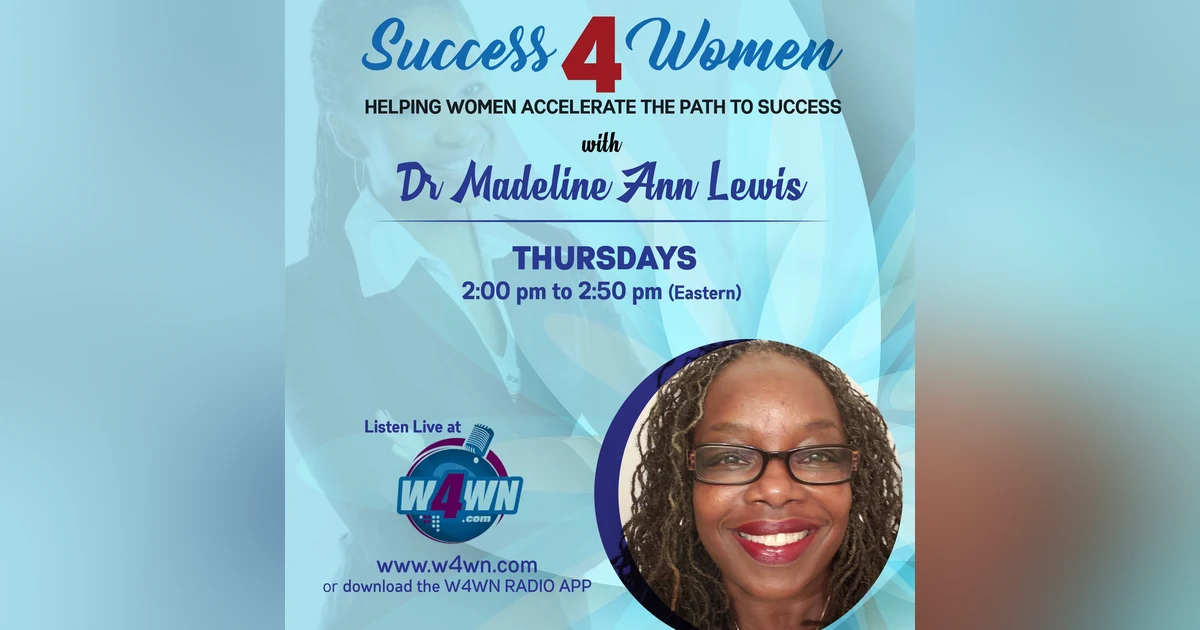
Success 4 Women is broadcast live Thursdays at 2PM ET on W4WN Radio - Women 4 Women Network (www.w4wn.com) part of Talk 4 Radio (www.talk4radio.com) on the Talk 4 Media Network (www.talk4media.com). Success 4 Women TV Show is viewed on Talk 4 TV (www.talk4tv.com).
Success 4 Women Podcast is also available on Talk 4 Media (www.talk4media.com), Talk 4 Podcasting (www.talk4podcasting.com), iHeartRadio, Amazon Music, Pandora, Spotify, Audible, and over 100 other podcast outlets.
Become a supporter of this podcast: https://www.spreaker.com/podcast/success-4-women--3126970/support.
0:00 The topics and opinions expressed on the following show are solely those of the hosts and their guests, and not those of W four WN Radio It's employees or affiliates. We make no recommendations or endorsement for radio show programs, services, or products mentioned on air or on our web. No liability, explicit or implied shall be extended to W four WN Radio It's employees or affiliates. Any questions or comment should be directed to those show hosts. Thank you for choosing W four WN Radio. Success, Successful. Pr Rise.
0:46 Successful Women. Did you know women represent just three of Fortune five hundred CEOs and less than fifteen percent of corporate executives at top companies worldwide? Have you wondered what the secrets are to getting into the top ranks, whether in the private or public sector. Do you want to figure out how to stop being held back in your career? Are passed over for promotion, then you're in the right place. Hi. I'm doctor Mattlananne lewis President and CEO of the Executive Women's Success Institute. I have decades of experience in the military, the federal government, and corporate America, and my mission is to help women succeed and tap into their full potential.
1:42 I want to reach a million plus women around the world to become the leaders they are meant to be. So if you want to move into a management or executive level position, or maybe you are a female veteran transitioning out of the military into business entrepreneurship, and reach out to the Executive Women's Success Institute at three zero one six nine three three two eight four. Let us get you on the fast track to success.
2:23 Well, Hello, and welcome to the Success for Women's Show, where you can view us on Talk for TV and listen to us on the Women for Women Network. I am doctor Madeline Anne Lewis your host, and my mission is to help women accelerate the path to success. Well, I tell you what I'm excited today to Welcome to the show, Doctor Eric Kelly the third, a visionary leader, founder of the Black Business Network, creator of the Black Business Olympics, and author of the true transformative new book, The Who, What, Win, Where, How and Why book Turn your imagination into Compensation. Today we're going to dive deep into how to build a team, one of the most essential elements of business growth and long term success. Doctor Kelly's sixth question framework, Who, What, When, Where, how and why shows us exactly how to turn imagination into compensation and how to build the right team to bring your vision to life. So if you're an entrepreneur, creator, leader, or dreamer, this interview will inspire you, stretch your thinking, and give you practical tools to strengthen your team and empower your vision. So you don't want to miss this episode.
3:53 My guest doctor Eric Kelly the third But before we bring him to the screen, I want to just give you a brief glimpse into something he is just famous for, and that's his Black Business Network. Prepare for what's coming and dominate in economic winter, stand strong and thrive by showcasing your great products and services globally. Through the Black Business Network and Black Business Olympics, the Black Business Network has showcased over two thousand companies with over seven billion in sales.
4:38 Each year. Over ten million attendees have viewed the rebroadcast each month through the Black Business Olympics, unique styles of business training and mentoring are turning students into business owners and entrepreneurial warriors who will dominate in any economy. Gain the ultimate advantage of the Black Business Olympics, seven days of unbelievable topics and speakers speaking around the globe. Donager, doctor Eric Kelly, the third Welcome to the Successful Women Radio and TV show. It is such a pleasure to have you on the show.
5:24 And it's a pleasure to be here amongst all the great women business owners all over the globe. You know, it's always great when I get an opportunity to share information that transforms lives. And of course the Black Business Network. You know, it's been a ride. You know, we're going to be doing the Black Business Network in December, and as I always say, what you're looking for is looking for you, and we are looking for business women all over the globe to be a part of our mission. And before we get. Into the introvert, I just like to say to you, to you doctor Madi and Lewis, you have. Been our rock in our network.
6:07 As each month when we do the Black Business Network, you are the featured the featured speaker to catapult us to the end of our show. As you come on Thursday night, it is really hot and really really right. Thank you, Thank you so much. I appreciate and you know, I just love the Black Business Network, the Black Business Olympics, and of course you're one of my favorite people. So it is such a pleasure again to have you here and to share some of your great nuggets that you're gonna share with us today. And you know, when I came on, I mentioned your book The Who, What, When, Where, How and Why? So we're kinda got I want to start off talking about that. So because then the topic of the show today is how to build a team, and your book will definitely help with that. For one thing, your book emphasizes the importance of identifying who is needed to bring a vision to life. So when it comes to building a business team, how can entrepreneurs better identify their who and who needs to be at the table?
7:26 Early on? Well, you know, the book was a book that I started writing in nineteen eighty two out of college, and I kept getting information and information and information, and people kept asking me how do I do what I do? How do I utilize my time to do so many things? Because many times people wonder about time, but they don't realize that we all have the same amount of time. What happens when in our time is how we use it. You know, I used to be on the speaking circuit, and I would talk to kids and talk to people about what they did, you know, and I talk about sports, and I would talk about how we spend a lot of times with basketball, football.
8:21 Track and a lot of sports. And then I would talk about the number of hours that we would use. And when you take those hours over a ten year period, you started losing years in your life. And then when you get older and you wonder where did time go? Where time sometimes goes as we become spectators of the lives of other people while our live is moving at the at the. Very same time. So when you ask that question earlier about the book, the book's title is building your operating system? Is your operating system as a person? And then what is your operating system as a business? And I call it the old I system. And what happens is many times we don't have an operating system. We just have a system of how we survive. And that system kills a.
9:18 Lot of time. You know. Your book also talks about the power of relationships as part of the WHO framework. So how can entrepreneurs build the right relationships when they're just starting out and they don't yet have a large network You know, because all of us when we start out in business, we definitely want to build, you know, we want to build as we grow. So how do you do that as a part of that who framework, Well, the. First thing that many people miss is that if you do the numbers about your ring of people. You know, I ran an advertising acy called Kelly Worldwide for a number of years and you know, when you go back to old advertising, there is some things that we metrics that we utilize, and one of the metrics is that everybody has a ring of two hundred and fifty people their actual network. And if you google if you google it how many people that most people know, it will say from eight hundred to one thousand people. But when you are doing advertising, it's about two hundred and fifty people.
10:37 But the first thing that you have to do is have clarity of vision. You know, you have to start with the why, you know, because most people are either influenced or they are the other word that I don't like to use that they are they are manipulated. So you gotta understand which one that you're doing. Are you manipulating people to do what you're planning, or are you doing the same things that other people are doing. So that shared vision of why is very important because you think about it for a moment.
11:17 This is a show that celebrates the beauty and the intelligence and the genius of women. So when you bring when you bring a woman with genius on your program, what happens is she's spending her time dealing with women, and so she's happy to be on your show. When you bring. Somebody who's not a part of that shared vision, then many times they come late, they don't show up, and they don't take it as take the show as important as the show is. And that's what's really important about building a team. You know, a team's vision is the most important part of why people show up, and then what they show up. Then you have to select the right people. You know, sometimes people show up for different reasons.
12:10 Sometimes they show up because it's a new activity. Sometimes they show up because they're familiar with who you are, but they're not familiar with your vision and with your goal. So the vision is important, and then selecting the right. People that is true. That is true now you know, and reading your book, one of my favorite lines from the book is how you describe the six questions as a road map for transforming vision into reality. Can you tell us how you you know, came up with that? What made you look at it that way? Well, especially using that you know, the how, the who what when we're how using that concept?
13:01 Well, you know, I got to give you a little part of the cheat code. And little part of the cheat code he is that I sold cars long, long time ago, back in the back in the in the eighties. I sold cars at a place called Kagan Planteact Mazda. And when I was there, there was a phenomenon that was going on on the dealership. There were three guys who were selling thirty cars a month. And I was trained by one of those guys by. The name of Charles McKnight, who sold thirty cars a month, and I watched how he developed his car selling and I sold twenty cars a month because I was trained by him, and I didn't and I didn't.
13:48 Want to do thirty cars a month. And sometimes when I said I didn't want to do something, people say, well could you have done thirty Well, business in life is about strategy and process. When you have the right process, then everything works. So the things that you want to do in terms of just life conversation is to understand what is the person's who? Who is the person? Why does the person want to do what you're doing, How do you do with your what is your process? And so when you establish your core values and your principles and your non negotiable principles. In other words, people many times don't think about it as your core values.
14:38 They don't think about what your communication system is, They don't think about how to build trust and respect. And so when you ask the question about the book, and the reason that I wrote the book is because many times. People don't look at how they move. They look at what they get out of how they move, but they don't look at how they move. And so those six principles are part of twelve twelve core principles of how to build a team. HM. So you're now when we go into the what section of your book that encourages readers to clearly define their unique offering. So how does understanding the what help business owners decide what roles or skills they need to add to their team.
15:33 Well, you have to have specific, measurable, achievable and relevant and time sensitive goals and deadlines. People move faster when you give them deadlines. People move faster when they can measure what you're talking about. People move faster when they see something that's relevant to what they are doing. You know, a many times I tell people, you know, it's easy to come up with a with a with a brand, it's easy to come up with a product, it's easy to come up with an idea. But if people don't want to do what you're doing, then they're not gonna do it. How to be a raving fans is to set clear goals. When you say the word what what is it that you are measuring? What specific thing is your goal? What reverent thing that's happening with what you're doing, and what is the time sensitivity to what you're doing.
16:44 When people get those clear goals and those clear deadlines, then they're able to not only do what you do, they're able to understand what you're doing as it relates to what they do. Okay, so then you go into your win. In the wind chapter, you talk about the importance of timing. So how does timing influence when an entrepreneur should start expanding their team and should they hire early or wait for certain milestones. Well, the first thing you must do in building a team is first build a strategy for your team. You know you have certain people that are gonna come on your team.
17:33 Put your hands together. You're gonna have mamon state, Mamon state, man mis state. I do apologize with that, but your time something you have to first look at. You know, the timing of the team members that are on your team. You know you're building a board. You may say, well, I got a board of directors. Okay, the board of directors are people who do the directing of your nonprofit. But then you have an. Advisory board in the advisory board of people who are people that you revere who advise you on your project.
18:19 Just the same with business. When you have a business, you have some people who you have to train. You got to invest in for growth, you got to mentor them, You got to create programs so that they can kind of catch up to the vision. Then you have people who are leaders, and those leaders are leading your company. When you ask the question about do you hire early or do you hire late, No, you hire the right people for your vision by doing what we were doing car sales, and that is to qualify people first. You have to qualify people cause many times you know you find people, you find the wrong people in your organization because you're thinking that they are free people. In other words, they volunteer to help you, and you're looking at them volunteering as a part of your growth. But they're volunteering because they have an agenda. Is that agenda your agenda?
19:22 And so you can hire the wrong people easily when you're looking at what they want to do. So you have to always be mindful of what you are actually doing. Okay, So I know that I was reading in something I think it was a magazine, CV Insights something like that, and one of the things that they said was sixty five percent of startups failed due to people related issues, not product or funding. How what do you think about that? Do you feel that that's an accurate statement and that people should really make sure that they look at that, especially when they're in business as solopreneurs, especially solopreneurs.
20:11 I think, yeah, well, I think it's I know they say sixty five percent. I say it's eighty five percent. Okay. The reason I say it's eighty five percent is it's just like building a house. You know, if you're building a house in you're using bricks to build that house and one of those bricks are not leveled, then that house is going to be built cricket, And the question becomes, when do you go backwards to go forward? And many times solopreneurs or I call them entrepreneurs, don't have the luxury of going backwards to go forward. So it's very important that you build a team with clarity. As we said earlier, that the team members that are coming to you understand and know exactly what your mission and goal is, and you understand and know exactly what their mission.
21:09 And goal is. Okay, okay, now we've kind of we're kind of going down the line with your book with the who what we're wearing. How So let's talk about the where. Your book highlights the importance of positioning the where when building a team. What environments, communities, networks should entrepreneurs place themselves in to attract the right people. Well, that that where is very important. You know, when I grew up, I didn't have a telephone an iPhone. I had a telephone, but I didn't have an iPhone. But back in the day, I had a telephone and I knew probably hundreds of telephone numbers.
22:04 And the reason I know on hundreds of telephone numbers were because they were my network to build businesses, to build with people. That was my network. Okay, now that we have an iPhone. When you ask the question where where, it's everywhere. Okay. Many times people don't understand. Once you find your audience and you're dealing with the psychographics of your audience, you know where they live, what they do, what they buy, what they need, what is their psyche, that's the where. And so when you're looking at a business of a young business, and many times most people talk about business and they believe that they want to start from the bottom and go to the top.
22:56 I always say that that is what's been pushed up groups of people, but you should always start at the top. In my book, I talk about the red the. Red, the red print, the green print, the green print, the black print, and I talk about where to start. The reason I talk about where to start is I talk about if you're in the industry, no matter what the industry is, you must first do research to research the industry so you can see what the industry is saying, not what you're saying. Because we get into emotionalrepreneurship and what that is, we do business how we feel as opposed to how the industry moves. And when you discover what the industry is doing, you really are starting at the top, and that's where everybody should start. And many times people say, well, I don't have ten thousand employees or I don't have five hundred employees. As a matter of fact, I only have two employees, me and my computer. Okay, that sounds good. But when you choose the right people to be on your team, then you're able to delegate what responsibilities that you need to actually build your team.
24:16 And many times you can build your team by hiring consultants yep, and consultants as long as you are paying them their rate and you are delivering to the client or customer what they need, then you can have a team as big as a thousand people. But we don't think like that because we get into what I call entrepreneurship where I have to do everything. I gotta do all parts of the business. And this is why we don't have teams, and this is why many businesses go out of. Business absolutely, And you know that. That brings me to another point where I was reading also where they say entrepreneurs tend to struggle with control versus is delegation because like you say, they they just don't want to, you know, turn it over. But also what you have to look at is, though, is managers who effect can generate higher income or higher revenue if they learn how to delegate, like you said, by having you know, bringing on others.
25:22 And sometimes it may be kind of a struggle you think you can't bring on another team member and things like that, but sometimes there are ways that you could do that, like you say, with a consultant, freelancers, you know, you can do some things like that. So it's different ways that you could do it if you need to do that. So, which brings me into the next area of your book, the how. So the how in your framework focuses on execution and strategy. So what are some practical how strategies from your book that entrepreneurs can apply when structuring or scaling their teams.
26:07 Well, you know, I want to comment on what you just said about control, and I want the audience to really think about war. And when I say war, I want you to think about how do you win a war? Okay, you're a business owner, you're in business. You really are in a war Okay, the CEO is the is the colonel. You know, you have generals. Okay, those generals are doing things. And then the generals have lieutenants, and your lieutenants are doing things. And your lieutenants have other officers. Yeah, other officers, and they're doing things. Okay.
26:52 So you got to ask yourself, are you a CEO or are you managing the business? Are you doing the work? And many times we don't realize that the control part of who we are sometimes keeps us from allowing ourselves to grow. And that's the most important important part about any business. How can you affect growth? When you ask about the question of how and where and why? And you ask this particular question, you must begin to integrate two things. Number one, you have to integrate right now, AI and social media. Number number two, you have to integrate partnerships and organizations and agencies. These two pieces will really build your business. When I begin to talk about AI, think about it for a moment. There are some ten twenty AIS that you can use. Okay, there's some ten or twenty automation systems that you can use. What are you getting back by using AI? You're getting your time back?
28:15 What are you getting back by using social media. You're getting your time and your exposure to new talent, to new audiences by utilizing those things. And many times you don't have time to engage in an audience if you're doing the work. When I do these business consultants, consulting seedes with people and I say to them that right now, this one hour that we're doing, you're closed. Your business is actually closed. Okay, if your business is closed in that one hour that you're that you're utilizing with a consultant, what is your company doing?
28:55 How is your company moving? And that's the piece that many times people don't look at, and that's why it's always important for the second part to that is to partner with organizations and agencies because when you start partnering with groups and nonprofits and schools and corporations and government agencies who are doing what you're doing, then you don't have to do everything. And the hardest part of business is is when you start a business is that there is no blueprint to that business. And so you get into business and you're doing everything. And what I say is take the time to slow down and build a strategy. Utilizing an AI, build a strategy of automating your system so you can schedule everything. Because these tools are producting, producted tools that help your team to be competitive. Think about it for a minute, doctor Lewis, you're in war and you bring a knife to a bazooka fight. Who's a Winzuka don't even have to be near you?
30:12 But I want to be near you with the knife to win. Right. That is the challenge that we have in business because many people want to want to be engaged in a knife fight against a bazuka. Wow, wow, this is you are giving us so many great niggets and so now we're going to hit on you the final point, which is your why. And in your why section you talk about deeper purpose. So how important is it that team members share or align with the founders why? And how can leaders communicate that purpose effectively?
30:54 Well, the first thing you have to do is sit down and ask yourself, why am I here? I think many times people are doing following the follower. You know, you decide that when you graduate from high school that you need a job, and somebody tells you where a job is, and the job is making a considerable amount of money, and you look at the money and you say, oh, great, I can make X amount of dollars, and then you take that job. Okay, and at sixty. Five you look back and you've given some thirty to forty years to one job. You never address what your individual why is in terms of who you are, and so now there's something called regret because you didn't get a chance to do all the things that you wanted to do while you're on the planet. That's why the why it's so important for you to sit down and figure out why am I here?
32:00 First of all? Okay, Now when you move into the business, you have to ask yourself why am I creating this business? So it's the shared vision that aligns everyone's energy that helps to create the purpose of success. Well to do it again to create the purpose of success. The clarity of that vision moves people to confidence, moves people to be raving fans of what you're doing. Not just fans, but raving fans. And what a raving fan is, that's somebody who's going to tell every about about what you're doing. So your why for business and your wife for life needs to be measured and then you build.
32:49 A strategy around that and not worry about. People who are not on your team, who are not about your product, who's not about your service, who's not about your vision. Because at the end of the day, it takes the. Same amount of time to do something large as it does to do something small. So we must begin to think large because it takes the same amount of time. Don't be follow a follower of the follower, or be a leader of the leaders. Be an individual that has a plan of what they want to do and accomplish on this planet.
33:30 Wow, now, your book, it really is a roadmap for turning imagination into compensation. So how can entrepreneurs use that same roadmap to help their team members develop their own creative strengths and contributions to the business. Well, the first thing you have to do in any business is to define roads and responsibilities. See many times we go into business and everybody wants to do everything. We got every guy who's never done marketing before, but now he's in business with you and now he wants to do market You have to curson the lady who's never done advertising, but she wants to do advertising. Then you have the guy or the girl who wants to do pr never done it before.
34:23 Then you got the guy who wants. To create the product for your or define your service, who's never. Done those things before. But now, because you're a new business and you're starting out and you have not done the research to know exactly what a company of corporation, a billion dollar company of corporation does, then you're in the same space with all of those other people and you can't really not only define who the right people. Are, you don't know why or what the right people should be doing. And so once you defend the roles and the responsibilities of people and clear roles, clere roles eliminate confusion and it really builds competition, but it eliminates confusion. So if I am a guy who does marketing and I've been doing marketing for years, then you have to lean on that marketeer.
35:22 But more importantly, before you lean on anyone, you must lean. On the information of the companies and corporations in the industry that's doing what you're doing. So you understand, am I talking about marketing your business? Am I talking about the sales part of your business? Am I talking about the advertising? Because each one of these roles are different from your established core values of what your team's foundation is all. About absolutely absolutely and we and we also know, I mean, we know that success come from building a team around the team. So a question I have for you is how can business owners leverage networks like yours, such as the Black Business Network to expand their teams beyond just staff.
36:17 Well, you know, early on when we came on, I said something that I hope everybody god and it's the most important part, whether it's with my network or with anybody else else network. I said that the average person knows two hundred and fifty people, which means that when you break it down and deal with those two hundred and fifty people who are aligned with your. Vision, then you're able to build a real team. See, most people don't do the numbers, and we could do quick numbers here.
36:57 I don't. I'm not gonna put my calculator out, but I'm going I'm gonna give you kind of an overview. Just imagine that your dream, your vision, your purpose was put in a box. I want you to take that box and I want to put a lid on that box with everything how you move your operating system, your business, everything that you do, and you put in that box and then you take that box and you sell that box to three one hundred people who are going to participate and utilize your particular system that's in that box. That's three hundred people.
37:39 You take those three hundred people, and then you recruit another three hundred people. That's three hundred times three hundred, that's nine hundred. That's nine hundred people, right, three and three six with six hundred people. Now take those six hundred people and you do or multiply that by another three hundred people, and do that twelve months at a time, you will have well over millions of people doing your one as we call your one why you one vision, your one project that you're doing. That's how you build a team. I'm gonna say it again, by duplicating.
38:27 Your services, your vision, your business, by duplicating what you do with people who are in your ring of people. That's how you really build a business and build a corporation and build a company without hiring people. Do it because many times people say, well, I can just hire people, Okay, The question becomes, when you hire people, how do you qualify those people clearly enough so that they are raising fans r exactly? And I mean also too, that their goal is the same is your goal, you know, as they work for you, because sometimes they may not have the same goal other than to be there for the paycheck.
39:20 That alies while why encouraging collaboration is very important for a team, you know. I can think back when I first started doing the Black. Business Expo back in back in eighty excuse me, back in eighty nine. I did not want to do the Black Business Expo. It was brought to me by my grandmother, and I thought it was a nice idea, but I didn't believe in it. And when she sat me down and told me about raising scholarships for kids, when she set me down and talked about how many business business corporations could not find competent black businesses, when she set me down and talked about the core values of what the Black Business Exbo was gonna be, and then I bought into it and realized that this was bigger than me.
40:23 And so once I understood it was bigger than me, then I began to think about how it could help other people. And in those days, people was looking for how to help each other build businesses, and so people were also looking at what they're going to do with their legacy and how they were going to help their kids, and the business Expo was giving our scholarships to kids also. So all of these things were resonating with me as a business owner. And the reason that it still exists today is because of how she planted the vision with clarity, how she selected me as the person and I was the right person for the job, and how she defined what my role would be, my responsibilities was gonna be.
41:21 How she shared with me what the core values of the black business what's gonna be. Thank you for that. How she created a communication system. With me, and how she made me each time that I did the show she would say, you didn't do the research. Each time the show would get bigger was because I began to understand how to do research. How she built trust in me and respected me as a man to clearly define and bring her goals and her whole ability for this show.
42:05 And that hasn't changed. Right, That hasn't changed in terms of everything that I do. The clarity of vision, selecting the right people, roles and responsibility, you know. Core values. These things are not going to change. And many times when we change in the extreme and start telling people what we're going to do. That is what I call the collapse of businesses. That's why businesses go out of business, not because they're not great businesses, but because of what I call consistency in business. Yeah. Absolutely, absolutely, doctor Kelly. It has been such a great conversation and you know it has gone by way too fast.
42:50 So tell us. I know that you do the Black Business Olympics every month, just quickly tell us about that when you're going to be running the next Black Business Olympics. And also let us know how the individuals can reach out to you if they have any questions or maybe want to be a speaker on the Black Business Olympics. Well, I'm going to start with the last first and in with the first last. I can be reached at Eric Kelly forty five at Gmail. That's for speakers to speak on our platform. The Black Business Olympics is one of the largest business showcases of businesses in the history of Black America in the world.
43:38 We've had more than. Ten thousand speakers to speak on our platform and they speak about business. Many times, people talk about being global, where the Black Business Olympics is global because we have global speakers speaking from Asia from Singapore, from Africa and now don't want to just say Africa and just leave it at Africa, Zimbabwe, South Africa, beneath Tanzania. We have speakers to speak from those different countries in Africa and and of course in the UK and all the states in America and of course in South America. And the key to what we do is we raise scholarships for kids to go to college to change their legacy because men of I our kids are committing suicide. Many of our kids are being wasted away in the human what I call scrap heap of time. And so with the Black Business Olympics allows for those kids to see us in a different space, to see business owners who are actually giving them life changing messages about business. And so you can also reach me at Eric Kelly forty FI five he gimmail for those who need to give me a phone call. It's nine one nine threeh eight nine zero nine zero. And as my great grandfather used to stay,
45:11 if you don't value your value, then your value will not be valuaball. And my grandmama would say, fear is a made up emotion that we utilize to stop and not do anything. And then of course I got to end with my quote, which is what you're looking for is looking for you. So I want you to think about it today as you leave this great show. And again I want to thank you, doctor Manland and Louis for allowing me to share your platform with all these great and brilliant and beautiful women all over the globe and looking at what you're doing. I celebrate you each and every day because I see the work that you do.
45:55 And for those who have not joined your organization, please think about where you want to be, how you want. To be, who you are. What's your reminder from my daily mindset? Thank you, don't forget to build you Doctor Kelly. It has been a pleasure having you on the show, and I just want everybody to know that today's conversation has been a masterclass in leadership, purpose, and the power of building the right team. Doctor Kelly has reminded us that success isn't just about what we create, It's about who we created with, when we take action, where we position ourselves, how we execute, and why we keep going. His book, The Who, What, When, Where, how and Why Book Turn your Imagination into Compensation, gives us the exact blueprint for turning imagination into compensation. And as we've heard today, that same blueprint is exactly what entrepreneurs need to build strong, aligned, high performing teams. Because when you because when you're who is right, You're what becomes clearer, Your when becomes strategic, your ware becomes intentional, your how becomes actionable, and your why becomes unstoppable. So, whether you're a business, you're starting a business, expanding a vision,
47:29 or building a team that can help you reach your next level, let today be your reminder you do not have to do it alone, and you're not meant to do it alone. So I want to thank doctor Eric Kelly the Third and all my viewers and listeners. Thank you for joining us on the Success for Women's show. I'm your host, Doctor Madley and Lewis, and I look forward to bringing you more conversations that will inspire, empower, elevate your journey. And if you would like to reach out to me, you can go to email me at info at e x w SI dot com. Thank you again for joining me. We're here every week. Please make sure to subscribe to our channel, our YouTube channel and to the UH Women for Women Network channel. Thank you again, Doctor Kelly. All my viewers and listeners, I'm doctor Madelananne Lewis, your host, helping women to accelerate the path to success.
48:30 Be well and stay safe out there. This success success successful women


