
The Bishop Concept

Join Dr. Lewis in a conversation with Lisa Bishop, founder of The Lisa Bishop. Lisa provides soft skills training, consulting, and executive coaching for various organizations. Her expertise is in leadership development, facilitation, coaching, and...
 iHeartRadio iHeartRadio
 Spotify Spotify
 Amazon Music Amazon Music
 Audible Audible
 Pandora Pandora
 Apple Podcasts Apple Podcasts
 Podchaser Podchaser
 Audacy Audacy
 Deezer Deezer
 Spreaker Spreaker
 Youtube Music Youtube Music
 Podcast Addict Podcast Addict
 Castbox Castbox
 JioSaavn JioSaavn
 Castamatic Castamatic
 Castro Castro
 Fountain Fountain
 Goodpods Goodpods
 Overcast Overcast
 PlayerFM PlayerFM
 PocketCasts PocketCasts
 Podimo Podimo
 Podurama Podurama
 Podverse Podverse
 Podyssey Podyssey
 TuneIn TuneIn
 YouTube YouTube
 RSS Feed RSS Feed iHeartRadio iHeartRadio Spotify Spotify Amazon Music Amazon Music Audible Audible Pandora Pandora Apple Podcasts Apple Podcasts Podchaser Podchaser Audacy Audacy Deezer Deezer Spreaker Spreaker Youtube Music Youtube Music Podcast Addict Podcast Addict Castbox Castbox JioSaavn JioSaavn Castamatic Castamatic Castro Castro Fountain Fountain Goodpods Goodpods Overcast Overcast PlayerFM PlayerFM PocketCasts PocketCasts Podimo Podimo Podurama Podurama Podverse Podverse Podyssey Podyssey TuneIn TuneIn YouTube YouTube RSS Feed RSS Feed
Join Dr. Lewis in a conversation with Lisa Bishop, founder of The Lisa Bishop. Lisa provides soft skills training, consulting, and executive coaching for various organizations. Her expertise is in leadership development, facilitation, coaching, and training. She has extensive experience in team building and employee engagement. For more than a decade, Lisa has conducted soft skills training for public agencies; and management training for non-profits. Email: lisab@thebishopconcept.com
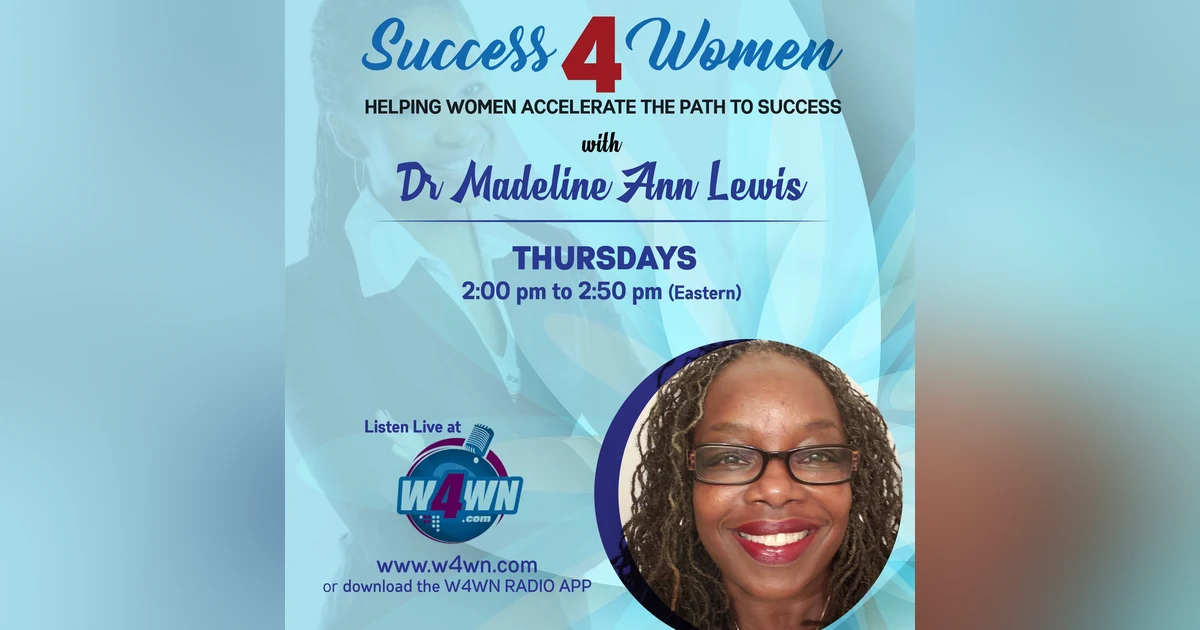
Success 4 Women is broadcast live Thursdays at 2PM ET.
Success 4 Women TV Show is viewed on Talk 4 TV (www.talk4tv.com).
Success 4 Women Radio Show is broadcast on W4WN Radio - Women 4 Women Network (www.w4wn.com) part of Talk 4 Radio (www.talk4radio.com) on the Talk 4 Media Network (www.talk4media.com).
Success 4 Women Podcast is also available on Talk 4 Podcasting (www.talk4podcasting.com), iHeartRadio, Amazon Music, Pandora, Spotify, Audible, and over 100 other podcast outlets.
Become a supporter of this podcast: https://www.spreaker.com/podcast/success-4-women--3126970/support.
0:00 The topics and opinions expressed on the following show are solely those of the hosts and their guests, and not those of W FOURWN Radio It's employees or affiliates. We make no recommendations or endorsements for radio show programs, services, or products mentioned on air or on our web. No liability explicit or implies shall be extended to W four w N Radio It's employees or affiliates. Any questions or comments should be directed to those show hosts. Thank you for choosing W four w N Radio. I got the time and then did you know women represent just three percent of Fortune five hundred CEO in less than fifteen percent of corporate executives at top companies worldwide? Have you wondered what the secrets are to getting into the top ranks, whether in the private or public sector. Do you want to figure out how to stop being held back in your career?
1:18 Are passed over for promotion, then you're in the right place. Hi, I'm doctor Mathelonian lewis President and CEO of the Executive Women's Success Institute. I have decades of experience in the military, the federal government, and corporate America, and my mission is to help women succeed and tap into their full potential. I want to reach a million plus women around the world to become the leaders they are meant to be. So if you want to move into a management or executive level position, or maybe you're a female veteran transitioning out of the military into business entrepreneurship, then reach out to the Executive Women's Institute at three zero one six nine three three two eight four. Let us get you on the fast track to success. Well, Hello, and welcome to the Success for Women Show, where you can view us on Talk for TV and listen to us on the Women for Women Network. I am doctor Madeline Lewis, your host, and my mission is to help women accelerate the path to success. Well, today's topic is the Bishop concept and my guest is Lisa
2:50 Bishop. So let me just give you a little bit of background about Lisa. Lisa provides soft skills training, consulting, and executive coaching for various organizations. Her expertise is in leadership development, facilitation, coaching and training. She has extensive experience in team building and in employee engagement. Lisa enjoys designing, interactive training, facilitating staff and board retreats. For more than a decade, Lisa has conducted soft skills training for public agencies and management training for nonprofits.
3:35 She is truly committed to empowering, engaging, and enabling employees to their full potential. Her goal is to effect positive transformation within organizations. Coach teams and executives, including initiators, decision makers, influencers, and intervention implementers. My us today, Miss Lisa Bishop. Hello, good morning or good afternoon wherever you are in the world. So nice to have you here. Thank you for inviting me. Yeah, it's great to have you here. I'm excited to for us to just chat for the next you know, fifty minutes or so. But before I get started, I always give them the standard bio all my guests, but I always like to say and ask my guests to tell us what you want to know about Lisa Bishop. If you're looking for an opportunity where you can communicate a little bit more effectively, if you've got team building challenges or feeling stuck, if you're in a situation where you're a leader, emerging leaders, season leader doesn't really matter, and you're looking for a trusted ally so that you can get passed where you are a trusted resource.
4:56 I'm an advocate. Now the topic is Lisa, I mean the Bishop Concept. Tell us about that. What is the Bishop concept and why did you Why do you call it that Bishop Concept? Well, my last name is Bishop. When I was a young girl, my father and I used to talk about business a lot, and he used to tease that he would be the CEO of an organization and I would be the president, and he would have different secretaries for every day of the week, and that I would run the business because I was always inquisitive and asking a lot of questions. That's kind of came when I was like thirteen years old. That's where the title of it came from. Initially. Bishop Concept is a leadership development firm that specializes in leadership development, obviously strategic planning, team building, conflict resolution, board retreats, and executive coaching. I've been doing it for ten years, over thirty five hundred participants in my workshops and training and probably now close to thirty different companies I've worked with. Wow, what are the three foundations of leadership? You do a lot with leadership, you know, you work with a lot of the executives and organizations tell us what the three foundations of leadership are. Self awareness. You've got to know who you are and what you bring to the table, where your strengths are, where your challenges are.
6:25 It makes a tremendous difference. Also, people awareness, knowing who your people are, knowing how to build relationships, knowing where they fit, understanding what their strengths are so they can maximize those opportunities for you. And also the cultural dynamics that are happening within your organization. You know, what do you do, how do you do things, who gets involved, who doesn't get involved, How you go about handling challenging situations, how you handle problems, who gets involved in the process, how you can bring people all around you know, the culture of the dynamic makes a tremendous difference, whether you have been in the organization for quite some time in quite season, or you're brand new and entering and don't have a clue. Because you can come into an organization and have all the credentials in the world, but you don't won't have the cultural dynamics which can make or break your success. Now in your travels and what you do the working leadership arena. Do you find that you there are more women that you have to kind of get them to understand what that leadership thing is that they need to basically progress up either the career ladder or in business. Do you work with more women than men or is it kind of equal? It's kind of equal. But I think my sweet spot is with women because obviously I am a woman, and we have different and
7:56 unique challenges that come before us. But getting to an arena where you have a trusted ally and resource. When you're in an organization, I can't come up to you and say, Madeline, I don't really know how to do thus and such, or I'm a little concerned about whatever. You're going to store that information and use it against me if it comes down to me or you having an opportunity to do something. And when you have a coach or you have a consultant, you get to start a think outside of the box. You see where you are within the process, and you see how it affects the organization as a whole, and you're able to sort of put pieces together that you wouldn't have otherwise thought of because you're so caught in the weeds.
8:41 If that makes sense, so do you think that when it comes to being in leadership, see a difference between the way women will lead an organization and the way men will lead an organization. Absolutely, revolutely, without a doubt, I have to say selfishly, I think that women do it a whole lot better because we're used to multitasking. Because if we are the bread winners, if we are bringing home the bacon and stirring it up in the pan and making sure the children are doing what they need to do, we have to learn how to compartmentalize kind of at an early age. We also know how to network a little bit better because we have different dynamics. Even within our own families. We have to understand who fits in where, what do they do really really well. If you can allow them to be able to navigate their way, if you will through the process of what they have to do, it makes a difference. And more importantly, women pay attention to small things that oftentimes men don't even consider. It completely goes away from them because they're all about the bottom line. That's not to say that women are not about bottom line, because we have to be, but we also know that in this climate where we are today, you have to know about the bottom line, but you also have to know about the people who are executing it and empower them to be able to make that happen by providing the
10:13 tips and the tools that they need to execute properly, as well as giving them permission to do so. Right, right, right, I know that what you just said those are some of the tools. Are there other tools required for our leaders to succeed in today's marketplace? Especial? And I'm gonna say, especially women especially, we sometimes have a We get a lot of pushback so to speak, when we're in those leadership roles we do. Part of that has to do with assertion, being able to communicate effectively, developing your inner personal skills, and building relationships. We gets so immersed in perfecting our craft, our technology, our wizardry that we forget that there's other dynamics that move through it. And these things are not taught in school. They're not taught in b school. Professionals who are attorneys, doctors, what have you. They are really great at their craft, but they're not necessarily great at relationships or dealing with their clients because those soft skills never come into play.
11:20 And as far as I'm concerned it should go from grade school all the way to be school. Wow. Absolutely, So what do you consider a key ingredient for successful leaders? A key ingredient again, is communicating effectively. I can't stress it enough, and people take it for granted and think that it's a touchy feely kind of thing. I don't even know why they call it soft, because it's an inherent thing. If you grew up having basic manners in the Bolden rule, you notice say good morning, hello, please, thank you. Those things do matter. And if you have someone who needs to get something to accomplished for you, and if you want them to perform, you need to acknowledge who they are, their presence value, who they are as a person. And when you're in a stressful situation, you need to be able to communicate in such a way where not only they hear you, but they receive the information and will execute and perform and produce accordingly.
12:22 Does that make sense, Yes, it does. It's so like a lot of times people will say I have an open door policy. But you know, because if I do believe that if you come in with a complaint, you should probably have some type of solution. But don't say, you know, I won't say I have an open door policy, but then when you come knocking at my door, I don't want to talk about it, and you know, talk to the hand. How do I have five? You know? So I think that's important too, And you hear that a lot people. I have an open door policy, but everybody's afraid to go and voice any type of opinion or suggestion or what have you to this person.
13:09 So to me, you really don't have an open door policy. It's very, very true. And it's interesting that you say that, because you know, part of that key ingredient is really understanding who am I dealing with? Who am I? What do I need? Some people when they're stressed, and I deal a lot. My training specifically center upon dealing with deadline stressful situations. We're very different when we're on deadline than we are when everything is moving as it should be. And so to your point, if I'm busy and something and somebody's beating on my door, I'm probably going to ignore them or turn the shades down where they can't see me at all, or ignore the call, ignore the email, or what have you. You have to know who you are that's part of that self awareness. This is who I am, and here's my preference. This is my leadership style. If you need to get me in a stressful situation, you need to send me an I am message, or you need to send me a text message or something that says this is urgent. I sent this to you at two.
14:11 I know it's five o'clock, but this is due tomorrow at ten and you had mentioned to us previously that this was important. Sometimes they get so immersed in whatever their challenges are, or their task or their to do or their mandate, they forget about the team who's supporting those efforts. Know who you are, Know the styles of your team and how they are motivated or incentivized, so that you can continue to perform and produce effectively. Now I know that since the pandemic in that lasted two and a half, maybe almost good and people have been working for how effective if your train them as far as the leaders, because you know a lot of people again are working from home, so they don't get that a lot of times may not get that face to face time. They're you know, they're in the zoom meetings or what have you, and still maybe not the same, you know, so how do you how do you help them with that as far as making sure that they can stay relevant as leaders and be able to still be able to lead their team and the task at hand. That's a great question. I'm glad that you asked. And being in this virtual society that we are, we're not going back to pre zoom, pre pandemic. It's here to stay people,
15:46 So you've got to get on board and you have to embrace it, and you have to figure out a way that's going to work for you and your team. As a leader, I highly recommend that you stay in touch with your team. If you're in touch with your team, you know what's going on behind the scenes, what happens. A lot of times as an individual contributors, they have the misguided notion that the boss knows exactly what they're doing. Not necessarily because to your point, they're very busy. They're doing so many different things and they're trying to keep it all afloat and keep you moving and motivated so that you can perform optimally. But you might be having a challenging situation that they may not be aware of. So I encourage team building. I encourage once a week touch base with their team, dependent on the size on their team, if they can have a one on one.
16:37 I think one on ones are imperative, but it's a two party system. The one on one is the responsibility of the person who's coming to meet with you. They need to be able to tell you, these are the five things that I just got finished working on last week, these are the things that are upcoming, these are the fires that need to happen where I need your support, and here's what's coming down the line. And then eventually you set up an individual performance type thing. So if you can do that one on one in a fifteen minute window, you've touch based with your people. They're connected, they're dialed in. It doesn't take that much time. You set a designated time so that it's repetitive and people look forward to it.
17:22 They have something that they can share with you. You get an opportunity to listen, provide input or redirect if the case may be, and you both have a copy of something that says this is what's going on. So when performance review time comes, you both are dialed into the progress or lack thereof, depending on what's happening. Because you can refer back to this resource. It's impactful, it's powerful, people are appreciative, and fifteen minutes, even though in this day and age it can feel like a lot of time, it's necessary. So I know, like I said, one of the things would be the pandemic, But what other things may have impacted the leadership dynamics of today or how people are handling the whole leadership thing. How has you know, what has been the impact of leadership dynamics, The shift, so to speak. The shift has happened as a result of the technology that's moving really really quickly, not being able to do business as you used to.
18:33 Is it hybrid? Is it not hybrid? Or they're going to have people coming back into the office. People have childcare situations. People have moved from where they were living initially because they can move further out and get more for their money and they're not incurring that commute cost that used to cost a small fortune. So they're dealing with dynamics that have to do with family structure, how people live, how they late, and if they're requiring those people to come back into the office or if it's going to remain that they get to be there, and there's plenty of studies that have shown and dictated or demonstrate it that working from home has been just as productive as coming into the office.
19:18 So you have people who are doing a quiet quitting. We've heard this term right. People are as little as possible, just enough to not get in trouble, just enough to say this is what I did. They're sort of following a script of their job description, but not going above and beyond as they were previously. And it's not just happening with the individual contributors. It's also happening with the bosses too, because they're burnt out because they're having to do more with less. They're having to the really on resources and technology that keeps shifting and changing, the dynamics of what's required keeps shifting and changing, so you have to be dialed into time. Taking breaks. Breaks didn't used to be a part of culprit culture right indeably in the twentieth century, twenty first century, not so much. You just keep going and going so that you can produce and produce. The pandemic has said we need to take a break. No one was designed to sit in a chair for eight hours and stare at a computer screen, you have to get up and take a break. Getting up to take that break gives you an opportunity to do a workout, gives you an opportunity to kiss you babies, comfort with your loved ones, return phone calls, go outside and water the grass, any of those kinds of things. And what I've discovered myself is when I take a break and I come back, I'm energized. I have a lot more energy, I have a lot more input rather than just staying you know, face
20:52 front. So for leaders, they have to know breaks are imperative. There's a mental health thing that's happening with people because they're still trying to recover from the aftermath. There's still a set of people who keep thinking that things are going to go back to normal, this is the new normal, embracing that and then trying to keep their teams motivated and incentivized when they don't really understand what's happening. And if you're not transparent and sharing or sharing your vulnerability, you're going to have a very challenging time in this marketplace. So share what you know. Also acknowledge I don't have all the answers. We're figuring it out as we go along, Come along with me. I'm going to still support you, I'm going to still guide you. But I do have I will share once I know more, you will have more information. I know you hear a lot about two, especially with the federal government, how they're trying to have individuals come back into the office, because right now a lot of them are paying for space that nobody's in. But a lot of people, as you said, they really don't want to come back into the you know, that brick and mortar facility. They feel comfortable working from home.
22:12 And as you said, some of them have moved, you know, further out to where they feel it's more convenient and and and cost effective for them. But I mean, if if something like that. But I also noticed that a lot of places you go into now they're short staff. That's right, That's right. It's like almost a lot, I'm telling you, just about every place you go they say, you know, there's that short staff. It's almost like nobody, like nobody wants to come to the facility. Nobody wants to work. If I can do it from home, I'll do it. But if I got to come there then not so much so that you have you also noticed that as being a huge problem as for us UM maybe affecting the training that you do in leadership. It is it's very interesting.
23:04 So what I do is I get together with leaders in their team, like just kind of training just recently in the last couple of weeks, where one of those elements that you were speaking about is paramount. They have to have the hybrid. They still get an opportunity to be away two days out of the week, but they are now required to come back in three days, and it's being met with resistance. There's challenges that are there people who are reluctant, there are people who are disgruntled. It is really an interesting phenomenon. And if there's flexibility and you can demonstrate that you can be flexible within that process, I don't think it will be as bad as if it was a hundred percent coming back in. Those who have to come back in one hundred percent may wind up leaving in droves. I mean, we've seen evidence here in the Bay Area San Francisco. Nordstrom is closing. Okay, that's a major department store. All of the anchor stores that support and rely upon their traffic coming in are also closing as a result of their not being enough foot traffic for the people coming in. That affects the restaurants, that affects the dry cleaners, that affects it's a trickle down effect, if you will. And so to your point, people who have to pay those bills or pay the pay that lease to the buildings that they're in are looking for
24:37 butts in the seats because it's necessary. That's part of their formula, that's how they made up. I would say there's always opportunities for them to rent out those spaces to other people who might need it and think outside of the box rather than the traditions of what they have if they want to keep quality, top notch people who produce in a major way. So there's got to be a paradigm shift that has to happen. Flexibility is key, and offer some sort of incentive that allows them to continue, maybe contribute to commuter bucks, maybe bring in something that's going to make a difference. Because you've got people who have finally got an opportunity to be able to see their little kid in a parade for Halloween, and now they're not going to be able to So there's a stress level. Bringing back in is going to create a new dynamic and a new division that's going to be focused primarily on stress and mental health. That's interesting. So how do you think a leader can gain respect in their field just kind of pig back in on what we've been saying, making sure that they are dialed in, that they are aware of what's happening
26:07 within their organization, being able to communicate, and build relationships. Those are the three cornerstone keys to everything. So it deals with emotional intelligence, It deals with communicating effectively, It deals with building relationships, and it has to do with understanding where you are and how to continue to move the pendulum to the right. Nobody wants to swing backwards, but understanding that is key to everything. And if I know who I am and I know how I'd like to assimilate and process for lack of a better word, but I also know how Madeline likes to do, that, I can communicate a little bit more effectively. Because in a stressful situation, I'm going to go, go, go, go go, Madeline might want to sit back and constantly and think about it. It doesn't mean she's not going to be productive. It doesn't mean She's not going to produce. She just has a different style. If I am aware and I'm paying attention, and I'm built a rapport and a relationship, and if I'm the leader, Malin knows that I want to have a conversation before bringing in the report. She on the other hand, wants the report first and the conversation later. So depending on who's in charge and that's required dictates understanding what is needed in order to continue to move forward.
27:34 When you're aware, when you give people the benefit of the doubt, when they are engaged in the process, you empower them to move forward. So what an important element and develop a highly effective organization? An important element is I keep saying the same thing. It really has to deal with your technology, your culture, and your communication. You need to be transparent as a leader. Tell the people what your vision is, break it down into bite sized chunks so they can go along for the ride and they can see where they fit in within the process. People want to know what you're doing, where you're going, and how they fit in. If you can demonstrate that, the sky's the limit for what you can do and how you can grow and be effective. So what do you think is the difference between a manager and a leader. Sometimes I think people get that mixed up. They really really do. And you can often tell what's important to someone based on what they share. And again, everything that I do in my training and coaching has to do with stressful, deadline driven situations. And there are people who are tasked driven and there are people who are people driven. You need both.
29:03 But a manager tells you what to do, and a leader shares information invites you in for the process. A manager is usually do this, do it right now, don't ask me any questions. A leader shares, ask for input and allows you to go along for the ride. If you're in a situation where there's change that's happening, you would prefer to be with someone who kind of shares their vision and provides direction, as opposed to a dictator who says, this is what we're doing, do it or else. When you don't have background information, when you don't know why something is happening the way that it is, there's a hesitancy, there's a reluctance, there's a resident in terms of if I'm going to move forward, and then you rely upon the sort of background noise and the unofficial mayors in the group who may or may not really be dialed in to the source of what's happening next.
30:08 And that turns into the gospel, which then turns into gospel. And that's how people move or don't move. And those are the things that I bring to attention to teams so that they're aware and at the end of the day, everybody really wants to see the best for the organization that they work in. They wouldn't be there otherwise when you invite them along for the process. They are engaged, they are empowered. They will move forward, they will move mountains in order to make things right. When you just tell them this is what we're gonna do, and you deliver it in such a way and walk away and they have no say so and no input, no consideration.
30:52 That's the difference between a manager and a leader. Now, we didn't really I think we may have touched on it focused too much on employee well being. Is that something that you help organizations to focus on too. I know you talked about the communication part and then like that. But one of the things I've been seeing a lot and reading a lot in you know, in different articles and stuff like that is about employee well being and how organizations should also start focusing on that, and I guess they mean especially those that are working from home, right right, because it makes a big difference. You've got to know what's happening with your team, where they are, where their strengths lie, where there may be lack where there's not enough information, do they have the tools that they need it Sometimes it's very lonely and isolating, depending on your particular role, and you know where you fit into the hierarchy or where you fit into the wheel, the spoke of the will of that team, and so making sure that you're checking in is a real thing because it makes a difference. There are some people who enjoy being engaged and want to have constant chatter, and there are some people who could care less about it and feel wonderful that they don't have to have that chatter because you know, not having those disruptions or interactions help them to continue to move forward.
32:23 But depending on your role and what your function is within the organization, it makes a difference. But employee well being is everything everyone has not covered from the aftermath of the pandemic and the effects that it has had on them financially, physically, socially or mental. Right, there's a whole dynamic that's there. You are right about that, So tell us. I know that you provide a lot of training to organizations, to executives, what have you. So what do you have coming up on the arizon anything that we need to know about. I'm constantly doing trainings that have to do with empowering women and making sure that they are ready giving themselves permission to do what it is that they need to do to be a better them. So look for me on LinkedIn. You can find me on my website, which is the Bishop concept dot com. I offer complimentary coaching sessions. If you mentioned that you were on Live Success for Women between now and the end of June, you can have a complimentary session with me for thirty minutes and you can reach me again at www. The Bishop concept dot com. I'm also speaking on the Black Business Olympics Expo coming up at the end of this month, and we are
33:54 this is may Can you believe it? Yes? It all over with It's incredible. So yeah, So, if you had one piece of advice that you would like to lead to our viewers and our listeners, what would that piece of advice be. Understand who you are, recognize your value and go for it. Don't let anybody tell you that you can't be in a room, you can't step in a room, and you don't have any right to be there. Go be and do That's what I would say, absolutely, And would you tell us again if someone wanted to reach out to you, how can they do so. My name is Lisa Bishop. You can find me on LinkedIn. It's the Bishop concept dot com www. The Bishop concept dot com. A leadership development consultant and executive coach. Wow, thank you so much. It has been a pleasure having you today on the show.
35:04 I am so happy that we were able to have this conversation and I will actually be looking forward to seeing you on the Black Business Olympics also because you always share such great information, so wonderful to that too, So again, thanks so much. Yeah, pleasure. I feel really great. It's a wonderful way to start the day and highly encourage all business leaders women in particular find out about Madeline, learn about life success for women and it's an empowering opportunity and there's always a wonderful time to be in the midst of greatness, because no matter what you know, we're still growing and learning and involving.
35:51 And I love women who are all about empowering, energizing and enlightening folks. So thank you. It's been a thank you too. Well, now I'm gonna share some upcoming events that I will be involved in. First of all, make sure that you pre order. You can now pre order your copies of the Own It anthology It's Your Life, Own It Unapologetically, which is the book and the journal. The journal three hundred and sixty five Days to Transformation, and they're both in paperback and you can order them separately. If you do order separately, both books separately or would be twenty four ninety nine each. And to order the complete set, which is the anthology and the journal, is forty nine ninety nine. If you decide that you'd like to get a copy, you can email me at info at exw SI dot com or go to my website www dot e XWSI dot com so that you can click on the links there. Also, as you heard Lisa Bishop mentioned, the Black Business Olympics is coming up. She will be speaking at the Black Business Olympics, and so will I it's taking place May twenty second through the twenty eight and as you know, the Black Business Olympics is a fundraiser to
37:24 provide scholarships and laptops to high school seniors going to college and K through twelve entrepreneurs. The Black Business Olympics showcases black businesses, black business owners and corporations all around the world. And so if you would like, if you'd also like to be a speaker to showcase your business on the Black Business Olympics, you can email me at again at info at EXWSI dot com and we'll look at getting you also on the schedule so that you can showcase your business. And I have to say, as always, if you have not viewed my tech x talk, then you must do so. Show up to Rise Up.
38:09 You can watch it on YouTube. Just put in my name, doctor Madeline and Lewis in the search box, or you can send me an email for the direct rec link info at EXWSI dot com and I'll send you the direct link to the YouTube so that you can watch it on YouTube. Make sure to check it out. I'm still excited because it's still moving up. It's at one hundred and sixty eight thousand, eight hundred and fourteen views right now. So again I want to thank all of you who have watched it, who have shared it, and who have commented on it. I really appreciate you. Keep pushing it out there, keep moving it forward is definitely appreciated. Also, I am also a contributing to the own It magazine where I share nuggets and articles every month. Own It Magazine is a resource for personal, professional, and business development. So make sure to get your subscription or an annual subscription to the magazine. You can go to my website which is www dot exwsi dot com and click on annual subscription and you'll be able to get a copy. Get your copies. So again I want to thank my guests, Miss Lee Subisia for joining us today. I would also like
39:42 to thank my viewers and my listeners for joining me today. This has been the success for women's show. I am doctor Madeline and Lewis and if you'd like to reach out to me, you can reach me on any of the social media sites. My email, of course is info at EXWSI dot com. Or go to my website www dot exwsi dot com and while you're there, make sure you download my three part video series on three things every woman should do to position herself for executive leadership. You can also sign up for my online course which is Cracked the Career Code how to Lead with Confidences, charisma and Credibility. To sign up for the online course, you can go to www dot eu Crack the Career Code dot com and don't forget. Make sure that you subscribe to our channel. Also like and share this episode with others, as we had some great information that was provided by our guests, Mis Lisa Bishop. Today again, this is a successful women's show. We're here every Thursday at two pm Eastern Standard time. I am your host, Doctor Madeline Anne lewis helping women to accelerate the path to success. Thank you again for joining me. I love you all to life and as always,
41:15 be well and stay safe out there.


