
Transitions & Messy Middles

 iHeartRadio iHeartRadio
 Spotify Spotify
 Amazon Music Amazon Music
 Audible Audible
 Pandora Pandora
 Apple Podcasts Apple Podcasts
 Podchaser Podchaser
 Audacy Audacy
 Deezer Deezer
 Spreaker Spreaker
 Youtube Music Youtube Music
 Podcast Addict Podcast Addict
 Castbox Castbox
 JioSaavn JioSaavn
 Castamatic Castamatic
 Castro Castro
 Fountain Fountain
 Goodpods Goodpods
 Overcast Overcast
 PlayerFM PlayerFM
 PocketCasts PocketCasts
 Podimo Podimo
 Podurama Podurama
 Podverse Podverse
 Podyssey Podyssey
 TuneIn TuneIn
 YouTube YouTube
 RSS Feed RSS Feed iHeartRadio iHeartRadio Spotify Spotify Amazon Music Amazon Music Audible Audible Pandora Pandora Apple Podcasts Apple Podcasts Podchaser Podchaser Audacy Audacy Deezer Deezer Spreaker Spreaker Youtube Music Youtube Music Podcast Addict Podcast Addict Castbox Castbox JioSaavn JioSaavn Castamatic Castamatic Castro Castro Fountain Fountain Goodpods Goodpods Overcast Overcast PlayerFM PlayerFM PocketCasts PocketCasts Podimo Podimo Podurama Podurama Podverse Podverse Podyssey Podyssey TuneIn TuneIn YouTube YouTube RSS Feed RSS Feed
Join Dr. Lewis in a conversation with Kelly Dwyer. Kelly is an executive coach, facilitator, and podcast host who helps leaders and teams unlock their full potential. She brings a unique blend of business insight and emotional intelligence to her work, guiding executives, founders, and nonprofit leaders through growth, change, and the messy middle. Kelly also hosts the podcast, Life from Within. Email: kd@kellydwyer.co. Website: https://www.kellydwyer.co
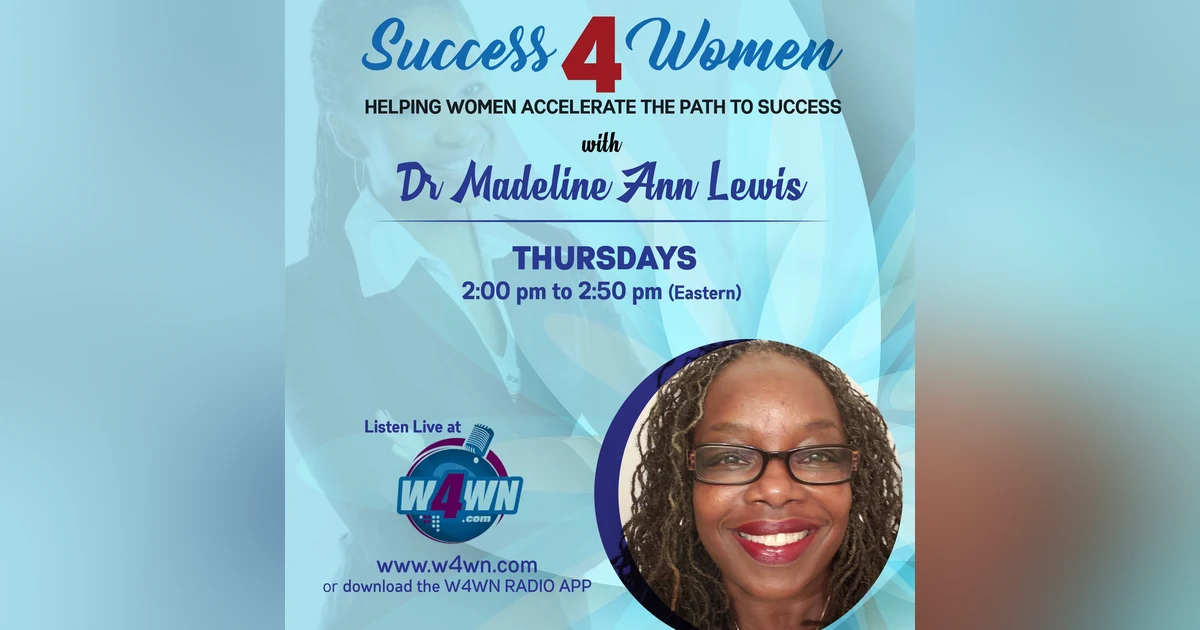
Success 4 Women is broadcast live Thursdays at 2PM ET on W4WN Radio - Women 4 Women Network (www.w4wn.com) part of Talk 4 Radio (www.talk4radio.com) on the Talk 4 Media Network (www.talk4media.com). Success 4 Women TV Show is viewed on Talk 4 TV (www.talk4tv.com).
Success 4 Women Podcast is also available on Talk 4 Media (www.talk4media.com), Talk 4 Podcasting (www.talk4podcasting.com), iHeartRadio, Amazon Music, Pandora, Spotify, Audible, and over 100 other podcast outlets.
Become a supporter of this podcast: https://www.spreaker.com/podcast/success-4-women--3126970/support.
0:00 The topics and opinions expressed on the following show are solely those of the hosts and their guests, and not those of W four WN Radio It's employees or affiliates. We make no recommendations or endorsements for radio show programs, services, or products mentioned on air or on our web. No liability, explicit or implied shall be extended to W four WN Radio It's employees or affiliates. Any questions or comment should be directed to those show hosts. Thank you for choosing W four WN Radios. Success Successful Women, Hard suns Rise Successful Women.
0:57 Did you know women represent just three percent of Fortune five hundred CEOs and less than fifteen percent of corporate executives at top companies worldwide? Have you wondered what the secrets are to getting into the top ranks, whether in the private or public sector. Do you want to figure out how to stop being held back in your career? Are passed over for promotion, then you're in the right place. Hi. I'm doctor Matlanane lewis President and CEO of the Executive Women's Success Institute. I have decades of experience in the military, the federal government, and corporate America and My mission is to help women succeed and tap into their full potential.
1:42 I want to reach a million plus women around the world to become the leaders they are meant to be. So if you want to move into a management or executive level position, or maybe you are a female veteran transitioning out of the military into business entrepreneurship, then reach out to the Executive Women's Success Institute at three zero one six nine three three two eight four let us get you on the fast track to success. Well. Hello, Hello, hello everyone, and welcome to the Success for Women's Show, where you can view us on Talk for TV and listen to us on the Women for Women Network. I am doctor Madeline Ann Lewis your host, and my mission is to help women accelerate the path to success. Well.
2:44 Today's topic is Transitions and Messy Middles and my guest is Mss Kelly Dwyer. Let me just give you a little background on Kelly. Kelly Dwyer is an executive coach for facilitator and podcast hosts who helps leaders and teams unlock their full potential. She brings a unique blend of business insight and emotional intelligence to her work, guiding executives, founders, and nonprofit leaders through growth, change, and the Messy Middle. Kelly also hosts Life from Within, a podcast about transforming how we live and lead from the inside out. I am so excited to bring to the show today, Ms Kelly Dwyer.
3:41 Hello, Doctor Lewis, Thank you for having me today. Oh, it's a. Great pleasure to have you here. We can't wait to have you share some of your nuggets with us. But before we get started, I always give the standard bio on my guests, but then I like to ask the question, just what do you want us to know about Kelly Dwyer? Tell us what you want us to know? What do I want you to know? I want you all to know that we're all in this together. We are all in process, we are all working with what's emerging, and we all have our conditioning and patterns that we're trying to transform. And so one of the reasons why I love the work that I get to do that you probably feel the same way or feel similarly, is that I get to learn as my clients learn, and I get to use the wisdom and insight that I'm gaining from my own experiences and my own transformation in life and help my clients with that.
4:52 So wow, And you know that brings me to my next question as to what first drew you into coaching and facilitation. What made you get into that arena. That's a good question. So I've been coaching and facilitating in some form or fashion for almost twenty years. It's only been full time for the last seven or eight. And first, way back when I got into coaching because I wanted to find work that felt meaningful for me, and I actually was a participant in a coaching program about how to find your purpose, and so I went through that program as a participant and then started to be mentored by the founder of the creator of that program, and then started coaching people through that program. So that was my foray into coaching, and it's evolved over the years into what it is now. And then as far as facilitation, I've also been facilitating groups, but the facilitation didn't really come into clear vision until I was working for this software company. I was working for an agile project management software company called Rally Software, and I was helping them expand internationally managing various strategic projects. And there was a project that I was working on where I facilitated a cross functional group of leaders through the research
6:26 and decision making process about where to locate our European headquarters. And I loved it. I loved the work. I loved helping the group make the decision together in a way that felt harmonious. Wow, that is very interesting. You know, we all have our different reasons for why we get into the areas we get into. But you know, when you're into coaching and facilitating, it takes a certain something that will draw you to that particular field. It really does, you know, because for one, it's going to bring you in contact with the lot of people a lot of times dealing sometimes with their personal, you know, lives. And so that's why, you know, I asked that question, because you just never know how you're going to affect someone when you're in that in that area and you have to talk to them about, you know, different things, different personal problems, even even if it's just their career or even business or what have you. A lot of times it still gets into the personal part of it.
7:45 Absolutely, And I firmly believe that none of us escapes childhood unscathed, and we don't leave our conditioning and patterns at home. When we go to work, we bring them with us. You know, it's always there. What did they what's that saying? Is that we live life? Uh? Is it we live life forward? But it's it's the past that we always have with us. I can't remember it goes now, but I do know it's always the past that even though it's the past, it's still always there. And some people can't break away from that that past, which is some it can tend to be unfortunate. But you know, so that's why sometimes you need coaches, you need therapists, you need you need the whole team. Oh yes, absolutely So can you share a time that you helped a leader move through a messy middle?
8:46 Yes? I'd love to. Okay, So this example or is a client who I worked with, and she was a newer executive and the team, the executive team was relatively small. They were on a four or five people right. Some executive teams can get up to seven, eight people and beyond. But that's a really big executive team. Uh. And the CEO was also pretty new. She was a first time CEO. I think she'd been in the role about a year. And so my client was we we were and she and my client was initiating a new function within the organization. So she was building a team, and she had gotten some feedback that she had some sharp elbows and so and so we you know, we worked together. We worked through what does that mean? What what?
9:39 Why are people? Why do people have that perception? What is she doing or not doing? What might she want to experiment experiment with changing around at least that piece of feedback. But there was also many of the clients I work with are so smart and which makes it really fun, and they're fast pros sessors. They think really fast. And so she had also gotten some feedback that she needed to bring people along, and that's a common piece of feedback for really smart senior leaders. They moved so fast. And stay two women probably I think both. I've had the experience of both. But okay, okay, And so we were working on those things. And on top of that, she was about to go out on maternity leave, and so we were she was developing her plan for how to get this new function to be successful and be able to function while she was out on maternity leave.
10:40 So we worked together prior to maternity leave, and then we continued our work after she came back from maternity leave, and by that and then when she came back, there were some dynamics had shifted on the executive team, so that was something new for her to deal with. Plus now she had two young kids that she was at home, and she had a very supportive husband, but he was also working and there's a lot to manage. Uh. So when when I say working with an individual, that's an example of helping someone through the messy middle of newness, a new a new, new ish role, some hard feedback, uh, dealing with a new a boss who's new in their new ish in their role, dealing with some certainty in the peer relationships. So that's an example of a messy middle.
11:35 And then there are lots of people I've worked with in career transition right or job transition, and that is a very definite in between. I usually use the word in between, but it does feel easy at times. Yeah, it absolutely is. To be honest with you, I've dealt well, especially looking at the female veterans when they're transitioning out of the military, because because a lot of times it's that mindset too, that that strict, you know, mindset that they have when they're coming out of the military, that it's like, Okay, you, when you're running a company or you want to start your own business or what have you, you can't really treat them like they're your soldiers.
12:19 You know that the soldiers under you. You have to kind of we got to pivot that a little bit. But yeah, yeah, different cultures, right, Absolutely, the environment and the culture and the way people are and people our personalities are all different, and so we respond to different styles of leadership. Absolutely. When you said about the sharp elbow, I was like, Oh, that's that's the new one, and I'd never heard that torm but I get it. Yeah. Yeah. I was just talking earlier this week with someone who had an experience with at a company where she actually ended up leaving because the people around her were pulling out their sharp elbows and she she wasn't ready at the time or willing at the time to go to the mat right so to speak.
13:14 Wow yeah, wow, So do you have a story or can you give us the story of a team that shifted once they learned to honor the differences, Like we talk about the different cultures and different things like that, Do you have an example of that that where a team the whole team just shifted because they learned to honor the differences. Yeah, there was a financial tech company that I was working with and this was an extended leadership team. And so that means that it was both the executive team plus the next layer of leadership. So a dozen people ish and the team. Are you familiar with Bruce Tuckman's stages team stages of development, the forming, storming, norming, and performing.
14:11 So they were in classics storming. They they came together and you know, in the storming for for this team and commonly for teams, when they're storming, it could. Look like. Individuals on the team having conflicts so openly butting heads with one another. It can look like certain individuals disengaging, just quietly disengaging, sitting back, just letting it, letting it all play out, without putting their voice into the mix. It could it could look like creating factions. So there were some factions that were starting to form, you know, many groups of people within the team that were starting to h oppose one another in a more formalized way.
15:04 So storming a lot of storming. And what we did is now when you're working with a team, You're working with all of these different personalities. You're working at a lot of different levels. I mean, when we're working with individuals, we're working at different levels too, We're working at the level of the identity and values and that whatnot. But when we're talking about a team, first of all, they need to have shared understanding of what it is there. What's the purpose of the team? Right, what is the purpose of their team? And what is the team trying to achieve together? Now I can't hear you. I don't know what happened to your audio? You don't hear me? Okay, you're not hearing me.
15:49 You were nodding though, so I think you could hear me. Yes, I can hear you. Okay, So yeah, I'm going to keep going. You work on your audio. So so the team, they have to have a shared understanding of what it is. What's the purpose of the team. Why are they a team in the first place? What is it that they are meant to achieve together or trying to achieve together? So some shared understanding. And then once you have the shared understanding, it's also important for the team to understand who's in the room, what are the personality tendencies that are present in the conversations you know, is someone? Are are a few? Who are who are the few people that are super dominant in the conversation, who are always going to be the first to put their opinion into the mix. Who are the folks that are super detail oriented?
16:43 Who are the people who just want the big picture and don't bother me with the details. So understanding personality is important. So shared understanding of where you're going, the vision, the purpose of the team, and the shared goal. And then an understanding of the personalities that are on the team and how that might show up in communication, how it impacts collaboration, how that might impact the ways that we are in that we have conflict with one another. Okay, And then. There was another thing that we did together, and we built some team working agreements. And I think this is this is great. This can be done even with a leader and one of their direct reports to build a set of working agreements. But with this team, we built some working agreements. And that means, how are we going to communicate? How are we going to engage in conflict when I disagree with you? We are we in agreement that we're going to be upfront and not be polite, I mean, not be rude, but not be so polite that we don't say what we need to say. Okay, So some team working agreements, and then I would say what was the other thing that we did? Now? I think those are the big three things that really helped that team move from storming into a place of norming.
18:11 So they had the team agreements, they had the shared purpose and shared goal, and they understood who was in the room. They understood better who their teammates are, which allows them to take fewer things personally. So when someone is doing their thing, it's not because they're doing it to me. It's because that's how they show up with everyone, and so it becomes less of a why is this person treating me this way? Right? M hm hm? Okay, are we back with your audio? Can you hear me now? No? I cannot hear you. Let me see if there's. How about changed the set? How about now? No?
18:52 Check my speaker settings? Okay, I'm checking them. Okay, talk now, Okay, how's that? Still? Can't hear me? Still not here? H I'm not sure what that is. Okay, let me try it different. Let me try something else. Okay, you're talking now, yeah, can you hear me? Hear you? I don't know what's happening. Yeah, because we're both fine. The engineer can hear it, can hear us both? I'm not sure if you can hear that. But okay, I'm unplugging my headphones now everyone headphones. Headphones are unplugged, and I'm just gonna move to I'm move to my lap laptop, microphone and laptop speakers.
19:44 Okay, how's that sign? Okay, we like can you hear me now? I'm so sad ah and we can both hear you. I'm plugging your hip. Yeah you did that. How do difficulties here? Keep the right right microphone? Only change the speaker setting, yeah, microphone. I changed the speaker setting to my MacBook Pro speakers. I'll go to default now talk. Okay, how about now? And still can't hear me?
20:25 Hm hm? I am at a loss? Okay, refreshing the page. Okay, so does that mean okay she has to come out? Okay, okay to my viewers and listeners out there, sorry for the technical difficulty, but we are going to get this straight so that we can continue. I can hear you. Now there her nuggets with us. Okay, she's back and STI can hear me, I can hear you. All right, we are back in action here. So the next question I have for you was, why do you think so many leaders feel stuck in the messy middle and how can they move through it? Oh?
21:11 Boy, I feel like this is everyone today in some regards. In some regards, Uh, well, I don't know about you, but the leaders I work with, they have their plates are so full to overflowing, it's incredible. And you have multiple stakeholder groups that you're trying to satisfy. So it could be let's say you're in classically middle level managers are the most crunched with this, right, So they've got they've got the executives demanding certain things of them, They've got their direct reports who are have their own demands and needs. You've got the clients or your customers who you want to satisfy as well, and so it's just there's so much on the plate.
22:08 And so. I think that and less a leader is disciplined about taking time for strategic thinking, then they are going to be consistently stuck in the messy middle. Overwhelmed and just completely reactive to what's happening around them. And that's one of the things I think coaching really brings is dedicated strategic thinking time. And that's how I position myself to clients when I'm potential clients, when I'm talking with them, I say, I really see myself as your strategic thought partner, right a place where a client a dedicated space and time they can come and they can hear their words reflected back. I mean, how many times have you had a client say to you. They'll say something and then you reflect back what you heard them say, and they'll say, oh, that's such a great idea. It's your idea, right yeah.
23:10 So uh so I think that this taking time for strategic thinking is thing one, and then the second thing is and none of this is rocket science. We hear this. I think it's just it's much easier said than done. The second thing is to really stay super focused on the few things that matter most. Wow, right, absolutely, I mean, because you know, as you said, it's it's always gonna be, You're gonna have that messy middle no matter what. Like you said, you got that messy middle. And the thing of it is to figure out how to really get out of it sort of speak, and that's what that's the whole point of you know, and and and again it's almost like the sharp elbows.
24:00 It's interesting that you call it that, you know, the messy middle, and that's really what struck my curiosity when I was reading about you and I saw that about the messy middle. I'm like, Okay, I really need to know what this is all about, you know, because the way you explain it, it's like I never thought about it like that. But it is a messy middle. Yeah, I mean, so we're you know, there are times where we are really clear about what it is we want and we are on our path to making that happen, and we know what the steps are that we need to take. And then there are other times where we're, I don't know, we fall into this pit of overthinking or being emotionally activated and not be able to get ourselves out of that. So on a personal level, that's kind of the messy middle for groups, though for teams, when I refer to the messy middle, it's actually a very specific thing when when a group is let's say a group is trying to answer a question together or make a decision together. There is a predictable process, okay, or a predictable trajectory journey that the group is going to go on. And that means so as long as they're the question they're trying to answer, the problem they're trying to solve is clearly articulated, they can start to have conversations and brainstorm and and put out ideas and
25:32 suggestions for how they want to answer this question or solve this problem. And what will happen is they'll get Yeah, So what happens is the ideas start to diverge, so you start to get lots of wild and crazy ideas, and then you get into this area that's called another it's also called the groan zone. Who initiated that, Sam Kiner? Sam Kiner, there's a great book for all of you people who want to be better facilitators of groups. It's called The Facilitator's Guide to Participatory Decision Making. Great book, and you'll see the groan zone in there. And the groan zone is when you've the group has been discussing this question or problem for a while, and you've gotten lots of different, very divergent ideas and opinions out on the table, and now the groups starts to get impatient because they want the answer to be clear, but the answer is not yet clear, right, and so you start to get bad behavior here. This is the why is that person keep saying the same thing over and over again?
26:41 And this isn't this process isn't working? Or what are we going to be done with this? Right? So all of the impatience and the bad behaviors start to show up. But if you if you persevere through, like in the conversation, and you have a facilitated process. So if you have a process, you're actually following to get to the decision. So you don't want just open discussion because that can go that can be too expansive. It doesn't have a container. So as long as you have a facilitative process and you persevere through the conversation, eventually what's going to happen is the group will converge. Now it might not be unanimous consensus, but the group will converge to a degree of consensus around what the right next step is, or what the answer to the question is, or what the solution to the problem is. And so that groan zone is the messy middle for in terms of the group dynamic.
27:38 Right, okay, wow, So how do you help leaders build clarity and confidence in high stake situations? I love this well, Claire. First of all, to get to clarity, you have to ask the question what do you want? What do you want? That needs to be clear? And then I think it's also really important to consider the contextual factors, the people who are also a part of this situation, the circumstances themselves.
28:25 Is there, what's the timeline associated with these circumstances, What other important factors need to be discussed and thought about in relationship to what you want? So, in other words, of all these things in your situation, what's going to stand in the way of getting you what? What's going to stand as an obstacle to getting what you want? What could aid you in getting what you want? So you start with what you want, you think about, you kind of examine context that you're in, and then you you could experiment or like figure out what's the next right step. So maybe you don't know the full answer yet, but you the client is able to discern the next right step or the next right conversation. They need to have to get more information, okay, so that they can then figure out discern what their next step is going to be. Yeah, So that's the clarity piece, and then the confidence piece really comes from trusting that. So if you discern, hey, I think this is my next right step or next right conversation, and even if that feels scary, but taking the action on that, you will feel more confident after you take the action. Okay, So the confidence
30:01 builds over time as someone takes small actions toward an ultimate resolution. Did that answer your question? Yes it did, it did. But tell me in all of this, what are some practical tools leaders can use to bring out the best say in the teams in their teams. Well, I mentioned a couple of them. Well I mentioned personality understanding the personality tendencies. There's a tool, there's a specific platform I use called clover Leaf, and clover Leaf is a wonderful tool where you can have basically you take multiple different personality assessments and all of the results are displayed on one dashboard for you. They're displayed on one dashboard for the individual, and then also there's a team dashboard that shows the results for all of the team members. So there's the visual, synthesized results. And then what clever Leaf has done is they have they basically the platform has AI driven coaching tips that you can use.
31:18 You can query the platform as a leader or as an individual, Hey how can I work better with this person? And the platform will say, well, given that this person likes a lot of structure and they like a lot of detail, when you're going to approach them and pitch them on an idea, you're going to want to make sure you're giving them enough detail, or you're going to want to tell them right up front, hey, here's what I'm looking, Here's what I want from you. Here's I want to have this conversation, and first I want to talk about this. Then I want to talk about this, and I want to talk about this. Sound good? Yeah, sounds good. So now you've given the person an outline for the conversation, so that gives them a level of detail that helps them feel safe to say, yeah, okay, I'm here, I'm ready, I'm listening, let's go okay. So that's one thing. So the clover Leaf platform that helps with the personality stuff. Okay, and then you know, with the team agreements. I think that anytime you're working with a group or a team, which is a group of people, but a team, a team is a group of individuals that has a shared goal. If they don't have a shared goal, they're just a group of individuals, right, So a team when you're working with a team, any time you want to build shared understanding with the team, there needs to be a process of brainstorming. Now it could
32:48 look different. It doesn't have to be whole group brainstorming right away, but there needs to be brainstorming. There needs to be synthesis as a group, and then there needs to be sort of the group coming to some degree of consensus around whatever it is, the set of team agreements, the decision to move forward, et cetera. And there's probably more here, but I felt like I talked a lot there. Did that answer your question? What challenges do you see executives and leaders facing most that they face most today?
33:30 You've probably heard a lot of people say this, but I and I know that the acronym VUKA the volatile, uncertain, complex, ambiguous environment that we're in today, right, I mean like leading leading through that is challenging. And so I again, I think it comes back to being clear about what you want as a team, as a company, as a person, being able to manage yourself and attend to your relationships the inner personal dynamics in the midst of that complexity and the pressure and the stress of the uncertainty and the ambiguity. So not losing sight of that, you know.
34:28 There you might have heard of this. In the nineteen seventies. There was a study done with seminary students and they were told so the experiment that was done was they broke them into two groups and they were told, okay, you students are each of you is going to have to give a lecture on the Good Samaritan. So that's like helping strangers, right, and they put then they so one of the groups they said, and okay, so you need to give a sermon on the Good Samaritan, and you have a few minutes. You can take your time getting over to the room, and then you're going to do it. Another group they said, oh, oh, actually you're late, so you need to get right over to the room to give your sermon. And so what they found and then they placed a person in a doorway in the path from one building to the next that was groaning and in obvious distress. And what they found is the group of people that was under time pressure just overlook them. Yes, by and large, the majority of them just passed by this stranger, which is so ironic because here they were about to go give a sermon on the good sperriton. Right.
35:46 Yeah. So bringing this back to the reality of the VUKA situation, the environment that we're all living through this pressure, being aware of the fact that the pressure impacts our willingness to show compassion for ourselves for other people. And so I think it's important for us to be intentional about slowing down, even for a little bit. Yeah, so that we can be more intentional.
36:27 Absolutely, we move forward, absolutely. Yeah. And it also kind of gives you a little clarity too, so that you can move forward when you slow down and just kind of let's clear your thinking a little bit, I think is what you need to do sometimes. Yeah. Yeah, h wow. So what's the most powerful piece of advice you find yourself giving leaders again and again over and over. What's what's that piece of advice? I think you know it? Okay, can I be pithy about it. I'm going to pull up I have the quote here, so there's a quote by Stephen Covey, and I think it encapsulates a lot of what we were talking about today and and the key so dealing with the ambiguity and the uncertainty and the complexity and the just the stress that everyone is dealing with. The key is not to prioritize what's on your schedule, but to schedule your priorities. So it really comes back to this idea of staying connected to what's important and making sure you're prioritizing time for that.
37:41 Okay, yeah, absolutely, that's good. That's good. So tell us what's uh, what's on the horizon, any any training, any new books, any uh products, projects coming up that you want us to know about. Well, I have a new podcast that I birthed and you had mentioned it at the beginning. It's called Life from Within and it's still early days with the podcast, but it's really about unearthing the wisdom and insight that we gain through our career challenges. So that is recovering from a career setback or making a pivot or up leveling in our careers. Maybe it's launching a new enterprise or stepping into the executive suite. So I talk with leaders and professionals about their personal growth and about the wisdom that they've gained as a result of career challenges.
38:42 We have four episodes live that are up wherever you find podcasts. It's called Life from Within. So I would love it if your listeners would go, take again, take a listen, take a watch. It's also on YouTube if you want to prefer to watch it. So, okay, just put your name in the search box and it should be able to It'll come right up right. Yeah, yeah, probably Life from Within and then maybe put with Kelly Dwyer and then you'll absolutely one hundred percent get it. Gotcha? Gotcha? So, Kelly, if someone wanted to reach out to you, maybe ask you a question about the messy middle, how could they find you?
39:22 I'm so glad you asked. You can go. They can go to my website Kelly Dwyer dot co so k E l l Y d w y e R dot co and there is a contact form on that website. You can sign up for my newsletter as well, and I'd be happy to answer any questions that people have and hop on a call. I'm also on LinkedIn. Kelly Dwyer. Is I think the handle my LinkedIn handle u r L it is. Yeah, I remember that, that's ow. I'm glad you remember. Make sure everybody knows it's KD at Kelly Dwyer dot Coco dot com, not com.
40:06 That's right. Yes, so that's my email address. Yeah, and so people can email me directly if they want exactly. So, just wanted to let everybody know our guest today is Kelly Dwyer. Want to thank you again for being on the show. It has been a pleasure. We had that little technical glitch, but you still gave us some great nuggets and we do appreciate you for coming and sharing your time with us. Thank you so much. Thank you, doctor Lewis. I really appreciate your generous spirit. So thank you. Thank you. Okay, so just to let everybody know what's going on. I just want to also let you know I was honored to receive the Prince Georgie's County twenty twenty five Excellence in Business Business Leader of the Year Award and guess what it was on my birthday. So normally for my birthday I go away, but this year I did not because I stayed to receive the award, which was double special for me and an honor to be able to be recognized by my community. So that was a great birthday gift to me. I'm also thrilled to share that I've been named one of the International Power Up Summit Award finalists in the Living Legend Top Women Over fifty category. This global recognition truly humbles me
41:36 a reminder. It's a reminder that purpose, perseverance, and passion only grows stronger with time. And the Power Up Summit, hosted by Current Sherry, is taking place at the reticin Red Heat Throw in London from October sixteenth through the eighteenth, so the award will be presented during that Actually this week, yeah, this week it's going to be presented. And don't forget the successful radio show made the list of the top one hundred best Career, Mindset and Working Women podcasts, and that we are probably sitting at number sixteen on the list, which is I think not bad if I have to say so myself. This list highlights podcasts that empower women to build successful careers, navigate workplace challenges, and find truth fulfillment in work and life, and I'm honored, of course to be among them. Also don't forget my new books Show Up to Rise Up Explore the Transformative Power of a Positive Mindset, which achieved bestseller status on Amazon in Women and Business, and it's now available for purchase. So if you're ready to embrace change and start living your best life, now's the time and this book will show you the way. And it's available now on Amazon. To get your copy, go to Amazon. You can put in
43:07 my name in the search box doctor Madlin and Lewis and the book will come up along with other of my books. And again. I also want you to remember that I am a contributing writer to the onw It magazine and I will be sharing well. I do share nuggets every month of resources, different articles on different things with them own It magazine is a resource for personal, professional, and business development. So make sure you get a free subscription, and you can do so. You can contact me if you like about a free subscription. Email me at Madeline at exwsi dot com for further details. And don't forget to make sure that you view my TEDx talk with just on my teedex talk which is also on YouTube, which I did of course you know I did it in twenty twenty one, but I am trying to reach that million mark. The topic was show up to rise Up. As I said, you can watch it on YouTube. Just put my name again in the search box, Doctor Madelann Lewis. It'll come right up, or you can email me at info at EXWSI dot com. Check it out, make sure when you view it that you share it with others. As I said,
44:38 the goal is to reach a million plus views, so I want to thank all of you in advance that have always already supported the video and has been continuing to share, like and comment on the video. We're over two hundred thousands views right now, so we're still growing and still want to hit that million plus views again. This is the success for women's show. I would like to thank my guests Ms. Kelly Dwyer, my viewers, and my listeners for joining me today. This is a successful women's show. I'm doctor madlin Ann Lewis, and if you'd like to reach out to me, you can go to info at EXWSI dot com or go to my website www dot EXWSI dot com and you can download my free three part video series on three things every woman should do to position herself for executive leadership. Make sure that don't forget to subscribe to our channel both the YouTube channel talk for TV channel. Subscribe, share and make sure you comment let us know what you think about the show. Again, this is the success for women's show.
45:58 We are here every week. I am your host, Doctor Madeline and Lewis helping women to accelerate the path to success. Thank you again to my guest Kelly Dwyer for joining me, my viewers and my listeners. I love you all to life and as always. Be well and stay safe out there. This is success. Successful Women heard Sunset da. Coomen.
46:42 I'm sy successful Women


