
Winners Don't Quit

Join Dr. Lewis in a conversation with Dr. Pamela R. McCauley. Dr. McCauley is an internationally recognized Industrial Engineering researcher, STEM advocate, university leader, seasoned entrepreneur, innovator, and STEM thought leader. As an...
 iHeartRadio iHeartRadio
 Spotify Spotify
 Amazon Music Amazon Music
 Audible Audible
 Pandora Pandora
 Apple Podcasts Apple Podcasts
 Podchaser Podchaser
 Audacy Audacy
 Deezer Deezer
 Spreaker Spreaker
 Youtube Music Youtube Music
 Podcast Addict Podcast Addict
 Castbox Castbox
 JioSaavn JioSaavn
 Castamatic Castamatic
 Castro Castro
 Fountain Fountain
 Goodpods Goodpods
 Overcast Overcast
 PlayerFM PlayerFM
 PocketCasts PocketCasts
 Podimo Podimo
 Podurama Podurama
 Podverse Podverse
 Podyssey Podyssey
 TuneIn TuneIn
 YouTube YouTube
 RSS Feed RSS Feed iHeartRadio iHeartRadio Spotify Spotify Amazon Music Amazon Music Audible Audible Pandora Pandora Apple Podcasts Apple Podcasts Podchaser Podchaser Audacy Audacy Deezer Deezer Spreaker Spreaker Youtube Music Youtube Music Podcast Addict Podcast Addict Castbox Castbox JioSaavn JioSaavn Castamatic Castamatic Castro Castro Fountain Fountain Goodpods Goodpods Overcast Overcast PlayerFM PlayerFM PocketCasts PocketCasts Podimo Podimo Podurama Podurama Podverse Podverse Podyssey Podyssey TuneIn TuneIn YouTube YouTube RSS Feed RSS Feed
Join Dr. Lewis in a conversation with Dr. Pamela R. McCauley. Dr. McCauley is an internationally recognized Industrial Engineering researcher, STEM advocate, university leader, seasoned entrepreneur, innovator, and STEM thought leader. As an Industrial Engineering researcher, she is known for accomplishments in the development of fuzzy set theory-based mathematical models, human engineering, ergonomics, and biomechanics as well as engineering leadership and women’s leadership in STEM.
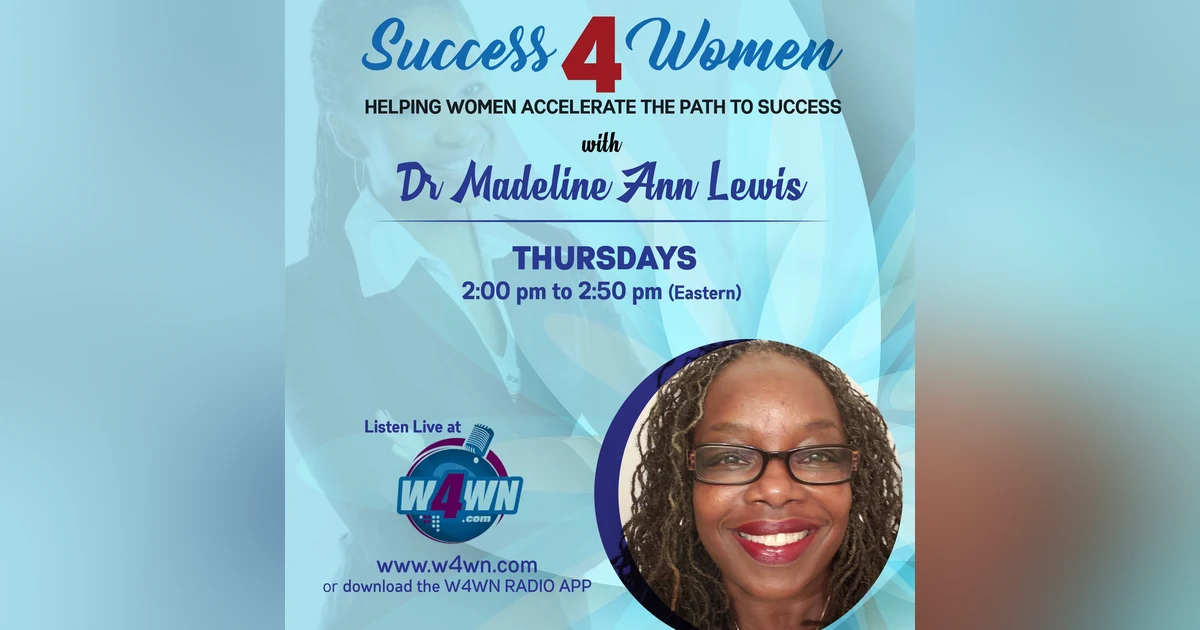
Success 4 Women is broadcast live Thursdays at 2PM ET.
Success 4 Women TV Show is viewed on Talk 4 TV (www.talk4tv.com).
Success 4 Women Radio Show is broadcast on W4WN Radio - Women 4 Women Network (www.w4wn.com) part of Talk 4 Radio (www.talk4radio.com) on the Talk 4 Media Network (www.talk4media.com).
Success 4 Women Podcast is also available on Talk 4 Podcasting (www.talk4podcasting.com), iHeartRadio, Amazon Music, Pandora, Spotify, Audible, and over 100 other podcast outlets.
Become a supporter of this podcast: https://www.spreaker.com/podcast/success-4-women--3126970/support.
0:00 The topics and opinions expressed on the following show are solely those of the hosts and their guests, and not those of W four WN Radio It's employees or affiliates. We make no recommendations or endorsements for radio show programs, services, or products mentioned on air or on our web. No liability, explicit or implied shall be extended to W four WN Radio It's employees or affiliates. Any questions or common should be directed to those show hosts. Thank you for choosing W four WN Radio. I got the time And did you know women represent just three percent of Fortune five hundred CEOs in less than fifteen percent of corporate executives at top companies worldwide. Have you wondered what the secrets are to getting into the top ranks, whether in the private or public sector. Do you want to figure out how to stop being held back in your career? Are passed over for promotion, then you're in the right place. Hi, I'm doctor Mattlananne lewis President and CEO of the Executive Women's Success Institute. I have decades of experience in the military, the federal government, and corporate America,
1:34 and my mission is to help women succeed and tap into their full potential. I want to reach a million plus women around the world to become the leaders they are meant to be. So if you want to move into a management or executive level position, or maybe you are a female veteran transitioning out of the military into business entrepreneurship, then reach out to the executive Women's Success in scat to at three zero one six nine three three two eighty four. Let us get you on the fast track to success. Well, Hello, and welcome to the Success for Women's Show, where you can view us on Talk for TV and listen to us on the Women for Women Network. I am doctor Madeline Ann Lewis your host, and my mission is to help women accelerate the path to success. Well. Today's topic is Winners Never Quit and my guest is doctor Pamela R. McCauley. Let me just give you a little bit of background about her. Doctor McCauley internationally recognized in industrial engineering researcher, STEM advocate, university leader, seasoned entrepreneur, innovator, and STEM thought leader.
3:14 As an industrial engineering researcher, she is known for accomplishments in the development of fuzzy set theory based mathematical models, human engineering, ergonomics, bio mechanics, as well as engineering leadership and women's leadership in STEM. She is a visionary leader and serves as Dean of the School of Engineering at Widener University. She previously served as the National Science Foundation Innovation Corps Program Director, professor and Director of the Urganics Lab at the University of Central Florida, and associate deans at North Carolina State University, as well as holding the position of Martin Luther King Junior Visiting Associate Professor of Aeronomics, Area Nautics and Astria Astronautics at the Massachusetts Institute of Technology. She is the author of over one hundred and fifty technical papers, book chapters, conference proceedings, and five books, including the best selling International Ergonomics textbook Ergonomics Foundational Principles, Applications and Technologies. Where all
4:49 of that said, I would like to bring on the show, doctor Pamela R. McCauley. Wow, that was about fault. Thank you, Doctor Madline. It's pleasure to be here, a pleasure to have you here to talk about some of the things that you've done. But before we get started. I always give the standard bio of our show guests, but then I like to ask that you just tell us what you want us to know about doctor Pamela R. McCauley. Well, sure, wow, Well, I thank you for the opportunity to be a part of your show and for the mission of what you're doing in terms of your efforts to accelerate women and certainly we're kindred spirits as it relates to that, and as far as other things that I would like for people to know about me that I am. I feel so fortunate to have had the career I've had. I've absolutely loved my engineering career, and so I have worked really hard to open the door for other women, other people of color to pursue careers in engineering and all STEM areas. Is because and that's something that doesn't necessarily come across in my bio, but that I feel like I've had a parallel career that's running right along with my engineering career, and that's trying to open the door to the joys of a STEM career at the educational level, the professional level, and even innovation and entrepreneurship for others. And so that's something that is near and dear
6:24 to my heart, and I hope hopefully that came out in some of the things you shared. Wow, you know what, it was so fascinating to actually read your background, your bio. Now that is a feel engineering. Are there a lot of women in that field or is it you know, small percentage, that's a small percentage. Only about fifteen percent of engineers are practicing and engineers are women, and the numbers are much smaller for women of color. And in fact, today I'm at a meeting at the National Academies National Academies of Engineering, Science and Medicine on a an action collaborative that is focused on that very thing. You know, how do we enhance the trajectories uh for women of color in technology? And so it's a it's a huge issue, and it's an issue not just because we haven't given times when we're given access, we don't get the opportunities for advancement or growth or don't feel that sense of belonging in these spaces. So that's that that's also very top of mind for me. Wow, that's fantastic. So what inspired you to pursue uh this particular industry and how did you become a trailblazer in your field.
7:44 Well, thank you. I appreciate the accolade of trailblazer, but I really I have just loved my work. You know. I take you back to when I was a little girl growing up in Oklahoma and on military basis, because my dad was in the army. My dad told me I was smart, and so I liked and I loved science, and he told me I should be an engineer. And you know, God blessed my father. What black man was telling his little girl she should be a doctor, you know, in the sixties and seventies. But he always made me feel smart and like I could do anything. And I had a wonderful, optimistic mother. And I liked I liked science, and I really enjoyed it. I would when we would visit my grandmother in Spencer, Oklahoma, out in the country, we'd i'd prayed, beg that we begged to see roll away bed in the summer months so we could look up at the stars. And I fell in love with the sky and the stars and the constellations, and so science was just always something that was really interesting to me. And I also so my father again told me I was smart, and so I should be a doctor. So I actually started out as a pre med major, but I realized quickly that medicine wasn't my thing. I really didn't like the sight of blood, so sorry. Remember telling my father. You have a conversation with my father about this, and I said, but and this is what I did, Doctor Madeline. I went to the engineering library because I to the library because I knew that I needed to switch for medicine. But I wasn't sure which engineering discipline to switch to, and so I looked at the
9:15 different engineering disciplines. And industrial engineering, which is what I ultimately chose, has the option to study ergonomics, which is a study of the human in the workplace, and biomechanics were looking at the body as a mechanical system, a biological and a mechanical system, and so that seemed really compatible with what I was interested in. So I chose industrial engineering, and industrial engineers also look at processes and efficiency, and I developed some computer and intelligent computer systems throughout my career, so it was just a perfect match for me. So I got my bachelor's and I also, let me tell you this, I was a young mother, so I said, I need to make sure that when I get my bachelor's degree, I can get a good job and be paid well. And so I looked at the salaries, and I mean, I was gosh twenty when I was doing this analysis and picked industrial engineering, and I have not looked back. I'm so so happy that I did.
10:13 And you know, it's amazing because, as you said, being a woman of color, it would seem that you would have kind of gotten off that path. So tell us what are some challenges. There's some significant challenges that you face during your journey of becoming an industrial engineer, and how did you you know, how were you able to overcome? Absolutely? And I've had many challenges and I share them freely with people because as much as I love my work and I'm excited about I don't want people to think that this just this was an easy ride, because when they run into difficulties, I don't want them to think that that means are on the wrong track. Just because you have some difficulties, that does not mean that you don't belong. That does not mean that you are on the wrong track. And so some know some of my issues, you know, even I'll go back to the educational issues I graduated from Frederick Douglas High School in Oklahoma City, and I was actually sixteen years old, So I graduated from high school early. But I didn't have the math preparation and some of the scientific preparation. So I went to community college. Thank God, I went to community college, and at community college, I was able to get up to speed. And I remember God blessed my high school math teacher everyon went back and she tutored me in her classroom when I was at community college. And so I think one of the things that I have learned I learned to do early was to ask for help. You know. Oftentimes when we have challenges, we feel like, you know, we just need to try to figure it out, you know,
11:43 or I should be able to handle this, but ask for help. People want to be there to support you when you have a dream or vision that you're willing to work toward. So I got my associate degree, and then at that point, you know, again the challenges from an educational staff were just really preparedness. So I encourage folks who think they might be interested in engineering, but they may not have had the math or the science courses that you would need to jump right into a bachelor's program to look at community colleges, so getting that associate degree because and then getting that associate degree that can help you get up to speed. And then many institutions, many universities also have bridge programs where students can come in in the summer and take preparate preparatory courses and help them prepare. So that's from an educational standpoint, those are some of my challenges. But getting the help and then just work in good old fashioned hard work and listen, they got resources today. We had to pull out books and problem solvers. They have solutions on YouTube, people teaching you how to solve problems, so you use, again, use all of those resources. So those are some of the challenges that I had and going to the University of Oklahoma. Fortunately we had a minority engineering program where that really gave us that sense of belonging because there were many other minority students there who were my classmates and we really supported each other. That's great information, especially I love the part where you talk about where you went to community
13:15 college, and I think that's an interesting point to bring forth because you may have a lot of individuals, especially young ladies, who might want to go into that field, but never gave it a thought that they could go to community college and get some book that. So that is definitely something that you know, needs to be put out there so that they'll know you don't just have to go to a top college, you know, uh, you know, find the biggest college that you can find, or what you feel is the most prestigious or whatever to get into engineering program you can you can, So that is at Wow, I didn't I did not know that. So that is information for me to have under my hat too. Absolutely, And I even go step further, I say, you will all talk here about the STEM crisis, how we need so many more STEM professionals in this country, particularly as we see the evolution of new technologies like AI. We're also starting to see you know, more innovations and technology in terms of product development, and so we do need those STEM professionals. But I have long said that community colleges and relationships between the community colleges and universities, that that is going to be the key to us really growing and addressing our growing STEM needs as a nation. And over fifty percent, over fifty two percent of STEM jobs actually can be obtained with an associate degree or less. So people often
14:46 think to be a STAM professional you have to have a bachelor's degree of master's And while that's fine if that's the path you choose, there are very solid needed STEM careers with an associate degree, and so I really encourage folks to look at that. And of course, if you want to become an engineer, you wouldn't need to ultimately continue on to the university and get a bachelor's degree. But the rewards are immense. I mean, the average starting salaries, depending on the discipline, range from seventy to eighty five thousand dollars a year with a bachelor's degree, and so it's really something that I encourage folks to think about, and it's a great career and many of our young folks. I love when I graduated, when I got my doctor degree, you know, you went to work for someone or you went to work for a national lab. But I love that many of my students are starting businesses, doctor Madeline. They are starting businesses right after they finish or during their PhD program and launching into these successful enterprises. And so there's so and there's so many resources that are available. So I as you can see, I am sold on stand and really want more and more people to take advantage of the rig and talking about it, I could hear how passionate you are about it, and you know it's it's good to know because another thing is when you talk about engineering, I mean you're in industrial engineering, but engineering has so many areas. As you said, you had to decide which that you wanted to you know, focus on, and there's so many areas of engineering that
16:19 they can go into and not an another thing too to be aware of and the you know, the community college can also help them to prepare them or to decide that also. You know, hey, you started off, you said, with your medical and you thought, well this is not for me. I want to you know, try. But when you got into the engineering then you had to decide which, you know, which area you wanted to focus on exactly exactly, And you're right, there's so many different engineering disciplines. You know, from aerospace engineering you shared that I was a visiting faculty member at MIT and the Aeronautics and Astronautics department, and so that that's certainly an exciting area. There's mechanical engineering, there's civil engineering. You know, there's also computer science, which oftentimes is in engineering programs or computer engineering.
17:10 So and what we taught we're taught as engineers is that we're problem solvers. So if you're a person who wants to solve problems, you are cut out to be an engineer. And I mean, it's it's just that simple. And then we're we're we teach the engineering problem solving approach, So we teach people how to use science to solve problems as engineers. And I mean, who doesn't want to make the world better by solving some problems? And don't we have enough of the challenges that we need to be working on. And we need diversity. We need diverse thoughts, diversity of thought, We need people with diverse experiences coming to the table and join the teams to solve these problems. So again, it's just a great career and it's been uh, you know, there have been times many times when I was the only one, only only black person, only woman, certainly only woman of color.
17:59 And in those times, you know, some of the strategies that worked well for me were aligning with my professional societies, finding other women who were in different states, Yes, building that network, network of support. So that that has been a lifeline throughout my career. And that's another thing that I always emphasized the women. You have to build a support network, especially you know, you said in your feel a lot of times you go into the room and you're the only one in that room that looked like you. So you really have to be able to walk out of that room and know that you have support, you know, somewhere else that you can go to when you need that, and that that is so key. So tell us how do you stay ahead of the curve and maintain you know, because you you've done so much you you you know, you have one hundred and fifty technical papers and chapters, and you know you have a best selling books.
19:00 So tell us how do you stay ahead of the curb and maintain your innovative edge in this what is we do know is a competitive environment. Also, how do you stay ahead of the curb on it? So well, I think one of the things that's been very helpful we mentioned networking. So actually networking, attending conferences, building those relationships and spending time understanding, you know, the things that are the new technologies and innovations in my field. But then also talking to people to understand what the problems of some of the challenges are. And then that has helped me be out there thinking about, Okay, so these problems need to be solved, these are some of the challenges.
19:47 And then having good collaborators. I love a good collaboration because no one knows everything. So having those good collaborations, oftentimes I won't even know that what I the knowledge I have is relevant for a particular problem until if I'm having a conversation with someone. And so that's really been helpful in terms of staying ahead of the curve and really understanding what some of the growing and emerging needs are. And you know, good old fashioned reading and today, I mean, we have your Google alerts, you know, for my discipline, I have Google alerts, so I get updates on things, you know, new things that are taking place and new ideas and so really just you know, networking, trying to stay on top of my discipline, and then understanding the problems that people every day are facing today. I mean, and when we've got what the United Nations Sustainable Development goals. I've spent a year with the US Department of State and in that time I traveled to Africa three times and traveled to Bangkok, and I was they asked me to help them understand how to introduce innovation into the HIV and AIDS healthcare service delivery process and see as industrial engineers as we study process and then of course with my specialty and ergonomics, I'm focused on people at work and how they interacted work, and so it was it was a natural fit for me in terms of innovation, you know, understanding at what point and so but I would have never known had I not talked to folks who were in the HIV and AIDS healthcare service
21:19 delivery process. You know that my skill set could be so valuable in these places. And I've said many times before and of course these are they wanted to look at how to do this introduce this innovation in developing countries because they may not have all the resources that we have in more developed countries, and yet they have the challenge that they're still dealing with in terms of HIV and AIDS, and we're expecting a huge population growth on the African continent. So there was a concern around that as well, and so I shared that I was never more aware of the impact of my engineering knowledge than when working on that were small changes. Small changes can impact the quality of lives for tens of or hundred of thousands of people. And so just understanding how to introduce innovation in a manner that is applicable in this community, that's sustainable and this is just my engineering knowledge and to see how it could impact it was.
22:19 It was so powerful for me to see that. And so when people tell me, oh, I don't want to be an engineer because I want to I want to do things that matter, want to change people's lives, I was like, well, honey, you definitely need to be an engineer. Engineers are changing people's lives every day. Absolutely, yes, that that would be a major I would say something major accomplishment because going into a lot of times into those you always could you know, when you think about Africa a lot of times you I actually, as you were speaking about it, I was surprised to hear like you said that, I don't know why that they would need you know, that technology, they would want to or they would have developed that type of technology to want to to make sure that they get all that they can and to bring someone else in in your industry to help them improve it even more. But that's that's actually very good to know that that they have the technology and they have the resources and all to draw and to pull you know, other resources in to help them to improve what there.
23:36 Yeah. Absolutely, and you know this is what this was done through the as I mentioned, the US Department of State and the office is the President's Emergency Program for AIDS Relief or the pep FAR Office. And so these are dollars that the US is investing you as a part of our outreach into these countries and just to support them. And so and when when looking at how to introduce technology, I did have to be mindful of the differences in these nations and the US, you know, and if the solution I came up with, you know, are they going to have enough power? Are they going to have access to the internet? And so we're starting to see a lot of growth and changes. So again, it was just so rewarding to be able to be a part of such an important project. I can imagine. Wow. So tell us or can you highlight any key, a key strategy or decision that contributed to your success in doing all of this?
24:38 And your success I call you a trailblazer, and I do really feel that that is what you are. So what has contributed? Can you highlight something that has contributed to that success? Sure? Absolutely. I think the biggest thing, Doctor Madeline has been not being afraid to do new and different things. And because often I mean I mentioned I graduated from Frederick Douglas High School, so you know, I'm first generation college student. Some of my cousins when I told them I was going to go to the University of Oklahoma, They're like, you know, why would you go down there? But that was the only you know, there are only two engineering schools. That was the closest engineering school to me. And so not being afraid to look at different things and go into different places where you might be the only person who looks like you. And so I think that's been a big part of it, that, you know, just that willingness to eat And even if I was afraid, I still did it. You know, you you still if you see this as an opportunity that it can better, you can better your situation, something that can move you in a positive direction toward your goals.
25:52 It's okay to be scared, but you can do it. Anyway you can still do it, you know, And I think that as well as as I mentioned before, reaching out and asking for help, and then I'm a I'm a big believer in mentoring. I've been blessed to have wonderful mentors, and so I would talk to people who had done the things that I wanted to do, whether it's starting an engineering business or becoming a professor, or you know, traveling internationally to work with the State Department. You know, I've had great mentors that I talked to about my career throughout from my undergraduate years to even today, and so it's it's been a joyful ride. But I wasn't the only one moving this car, I mean not at all.
26:44 I've been so blessed and again that you know, not not not letting fear stop me, you know, going anyway and building that network, talking to people, asking for help and and getting you know, good mentoring and good guidance has just been priceless as far as my career. Wow, I can see that, I mean from some of the things that you have done and you know, the things that you've created and help to implement. So I can definitely see that what has been or what are some of the most important trends or developments you see shaping your industry in the coming years. Wow, well there's a few. I mean obviously everyone is concerned about artificial intelligence.
27:30 Yeah, and my research looks at the human side of systems, and so understanding how AI and human interaction as relates to artificial intelligence is something that's going to be a research area that we really need to continue studying. Also, the mobile technology and access to all of this mobile technology and Internet of things. You know, everything is connected to the internet. Really understanding how that impacts the user users who are on devices all the time. I have a I also do expert witnessing, and I you know, there's a case where the person's distracted. So people are distracted and walking with cell phones and walking into streets and getting into or falling right, So understand, you know, how do we design these devices so that they can be sensitive to what's going on with a person and then then begin to respond. You know. One example is, you know, if you're driving your car and you pick up your cell phone you try to text, it will say or some of some of the phones will say you know not or put a little sign up do not text while while driving because the technology sensing that you're moving that too.
28:48 Yeah, and so these are all anything that any system that the human has to interact with could be under a research area, you know, within ergonomics or human engineering or human factors. And so the list is so long because technology is moving so quickly. I mean, we have seen such a compression of the innovation and product development life cycle and so now we think of an idea and six months later we have prototypes and so, you know, and then we're perfecting it and we're getting these products out here, but we haven't really evaluated how humans interact with them. So there's a huge need for continued research in this space to understand, understand, also to enhance use, but more importantly, to make sure that these things are handled in a safe manner.
29:38 Right, absolutely, Yeah, I mean that's one of the things that I have decided I need to learn more about the you know AI and what is the chet GPT and all that. Yeah, it's wonderful, it's one I mean, there is and we're having to deal with this in the academic environment, you know. As dean of engineering, I'm concerned that my students are not cheating that they're actually writing the papers and learning the material. It's what you want. I I was telling someone that just the other day, Like you can, a teacher can ask this thing to write a whole program for the link. Just tell them what they want. They write the whole curriculum and all that I mean, and go in and tweak it a little bit if they want. It's fascinating. So the good part of this, though, is it can help us be much more productive. You know, inte, you're talking about a teacher. If you know, if you're a teacher and you've got seven classes you're teaching, and so you need to get your lesson planing ready quickly. So it could be something wonderful to help you get that lesson plan ready. And as you said, then you tweak it.
30:47 You make sure you make it relevant as some culturally relevant examples for your students, and so so you have greed created your course material probably in one fourth time that it would normally take you to do so. So so those are wonderful things. And even problem solving sometimes you know how to solve problem you don't even have time for One of my expert witness cases the other day, I needed to determine how a person who was hit by a car, how they would fall, if they would fall back, or if they would fall to the site, because that's again biomechanics. So I told Chad GPTs, I said, I said, please calculate the center of gravity for a woman who's this height and this X, Y and z, and it gave the center of gravity. So I was able to quickly solve the problem. Now I know how to do that myself, but it was it's wonderful when it's used properly, and that you know, that's the then you know the fine line that we're we're going to have to learn to walk because it's wonderful in many ways, and we want to allow and equip and educate our students and our employees on how to use it in an effective and ethical and safe manner. That said, we have to be very careful that we are putting those guidelines in place, and I think the White House just put some additional guidelines. I mean everyone's looking at it, from the White House to the academic communities and workplaces. So it's so it's that's going to be something that will be working on for many years to come as far as I can see.
32:17 Yeah, that, uh that it's such a you know, it's it's out there and you know it's out there, and of course you I feel, you know, being in business, I have to you know, figure out how it works. I mean I don't I don't think I need to be an expert in it, but I think I need to understand it absolutely. Yeah. Yeah, so just to you know, I need to figure out is this something that I really need to implement in my in my business or what I'm doing. And so that's that's one of the things that I have been looking at as far as exploring it to see how helpful it'll be, you know, for making, like you said, making my life easy.
33:00 Absolutely. I mean I know how to calculate the center gravity doc Madaline, but when I asked her to calculate the centergravity while I was working on something else, by the time it had the center graphy calculated, I put my put the information in there and solved the problem in less than half the time. Yeah. See that that that helps, that that helps to know that. So I definitely I'm definitely gonna make that a priority. Yeah, I need to figure out this thing and and really get into it now. So tell me. I know I mentioned in when I was reading your bio that you are dean right now. A school of engineering is at Widener Universe University, So tell us how do you foster a culture of creativity and innovation within your organization? Well, and that's something that I'm glad you asked me that, because that's something that's really important to me. I think one of the best ways to create that foster that culture of creativity and innovation is to build it around needs. People are much more willing to solve a problem if they feel like it meets a need, it addresses a societal issue, it is going to help make life better for someone, and that's very easy to do in engineering. So really building around and then of course even in engineering education, when I talk to my faculty members or my leadership team about making sure that the things we do are designed to make it easier for our students
34:34 to do well, are able to easier for them to acquire an understanding apply the material in a more efficient manner. So people are more likely in my experience, to be innovative and creative and resourceful when they feel like what they're doing is really going to have an impact on a situation, individuals, or even a community then and that's sort of a different perspective. Maybe then some technical professionals would take. But I found that to be so much more effective because then at that point, then the next thing I say is collaborate. So collaborations. When I've got my doctor degree in ninety three, people were looking to be the loan researcher who's going to save the world, and those days are very, very long gone. Today it's about quality, substantive collaborative relationships. Because we have I mentioned the compression of the innovation and product development life cycle. Well, there are multiple disciplines, multiple backgrounds that are needed when you start talking about innovation and really solving a problem. So having those good collaborators that you can come together with and share your ideas in brainstorm to get to solution is just essential. And we've seen that people get to solution much more quickly when they have these substantive collaborations. Not just two people say we're going to work together. I'll go to my office of work, you go into years of work and we'll talk in two weeks. No actually looking
36:06 at the problem, looking at where to apply the industrial engineering or the mechanical engineering expertise you know, or where do we need social science expertise as a relations to solving this problem? And so really having those good collaborations that are focused on meeting needs, addressing challenges that has been very effective for me and keeping people interested in innovating and being creative. That is great, that is phenomenal. So tell us if you had one piece of advice that you would leave with our viewers and our listeners, especially to maybe motivate someone who wants to get into the engineering field, what would that advice be. I'm going to borrow Nike's phrase, just do it us do it. We need you, We need you in these engineering field, we need you in other stamp disciplines. And believe me, it is probably easier to enter than you think.
37:14 You mentioned the community college. Start a community college, you know, most community colleges have an open door, open enrollment policy. You know, you can you don't have to be accepted, you can just enroll UH and then talk to people, talk to the counselors, you know, UH, academic advisors, talk to people about your ideas, and do a Google, you know, do a Google search. You know what are some if you like playing video games? You know what are some fun careers for people who enjoy playing video games? Maybe you should be building video games and getting paid. Okay, you know, you know, if you really enjoy helping people, you know, we used to think that was only social science or nursing disciplines. You know that's not the case at all. You could become a biomechanical engineering design prosthetic devices for children to run who don't have legs, and so really understand, just do it and don't be afraid. And I'm gonna say this, if you are afraid, do it anyway. Yes, absolutely, any way. The rewards so outweigh the fear and the challenges. The rewards are immense. And I want so much, so very much to see more of pursuing, succeeding and enjoying careers in engineering, because again, we are desperately needed in this space. Absolutely so. Tell us if someone wanted to get in touch with you to maybe ask you some questions for you to
38:45 maybe give them a couple of tips, a couple of pointers on your industry, your field, how can they reach out to you? Oh, I'm easy to find. You can reach me at my university email It's just pr McCauley at Widner dot EEDU or go to the university website you can see my contact information there. You can also contact me on LinkedIn and I also have course on an engineering business that has transformed your STEM career, so you can put in a question fill in the forum there. So I'm really easy to find and would love to connect with folks, offer any insights that I can to support anyone on their journey. Oh and real quick, I don't want to go without letting you tell us how they can get your book, which is winners never you know how they can do. If you go online and go online, they can get it. Or they can send an inquiry directly through my business and I will get them to our point of contact who handles that. So would love that and would love to And part of the reason I wrote that book, docor Methlant, I would go and talk to students at high schools. This is right after I finished my bachelor's de and I was ingredul and people would say, gosh, I wish my son or my daughter were here, my cousin were here, and so I thought, well, I'm never going to be able to make it to talk to everybody.
40:08 So I wrote that book because I wanted to share the challenges that I had as an undergraduate student and those difficulties, and yet I was able to not only get my bachelor's degree, but then win a huge fellowship and pay my master's and doctor degree. And the message is so can you. And it's then we have so many more resources today so they can reach out directly to us or get online and be happy to help them get a copy of that. Thank you so much. And you said just what this show is all about. If you did it, everybody could do it. And that's what I with this show. You know, don't think that because you know she did it and it was a piece of cake, because like you said, it wasn't it. But you have to stick with it if you're absolutely like the book said, winners never requit. So thank you so much, doctor McCully for being here. Appreciate nuggets that you shared with us, And I just can't thank you enough for giving us some information that, like I said, some of it I didn't even know. So definitely appreciate you taking time out of the busy schedule to be here and just let us know if there's anything reach out, let me know if there's anything that's coming up that you want us to make an announcement on that. Can you know, help your program or help what you're doing in any way, be glad to do so.
41:37 Thank you, Thank you, that's so kind of you. Appreciate that. Thank you. So here are some upcoming events that you can where you can find me, and some things that are going on. Again, make sure that you get your copy of the Own It anthology It's Your Life, Own It Unapologetically and the journal three h hundred and sixty five days to transformation. To pre order the paperback book and the journal separately will be twenty four ninety nine each for each book. To order the complete set is forty nine ninety nine. To order your copies, you can email me at info at EXWSI dot com or you can go to my website www dot EXWSI dot com.
42:30 The next Business Black Business Olympics is coming up soon. It's going to be December eighteenth through the twenty December twenty fourth, and as you know, the Black Business Olympics is a fundraiser to provide scholarships and laptops to high school seniors going to college and k through twelve entrepreneurs. The Black Business Olympics showcases black businesses, black business owners and corporate rations all around the world, and if you want to be a speaker to showcase your business, you can email me at info at EXWSI dot com. Also coming up on the horizon is the which is January twenty fifth through the twenty seventh of twenty twenty four is my Show Up to Rise Up Women's Virtual Summit. To find out more about the event or to be a speaker at the Show Up to Rise Up Virtual Summit, you can email me at info at exw SI dot com. And we're also going to be starting a Show Up to Rise Up Women's Network and the mission of the women's Show Up to Rise Up Network will be to empower and connect women all around the world in their career, business, professional and personal lives by how helping them to gain the resources needed buying power, increase
44:04 their revenue, and to accelerate their personal business and career growth through opportunities that they will be able to find through the network. As a member, you have access to coaching, training, events, workshops, resources, networking opportunities and much much more. And of course I will be doing my Show Up to Rise Up Women's retreat in twenty twenty four, so for the details on that, make sure you contact me. If you're interested in joining us in twenty twenty four, you can email me at info at EXWSI dot com.
44:45 And as you know, I have to put it out there, make sure that you bow my TEDx talk that I did in Vancouver, Canada. The topic of course is show Up to Rise Up, and you can watch it on YouTube. To watch it, you can go and on YouTube put in my name in the search box, doctor Madeline and Lewis and it will come right up. You can also if you prefer to email me directly for the link, you can do so email me at info at EXWSI dot com and I will send you the link. I am excited because the video is still moving out there. It's at one hundred and ninety three thousand, eight hundred and ninety views. As you know, I'm pushing for a million plus, So keep watching, keep sharing, keep commenting, and I want to thank all of you in advance that have supported the video so far, who has shared it, and who have made their comments. I am also a contributing writer for on It magazine, where I share nuggets and resources every month.
46:00 Own It Magazine is a resource for personal and professional and business development. So if you'd like to get a subscription to on It Magazine, you can go to my website www dot e x w SI dot com and there's a link on there if you want to get a and your membership. If you'd like to get a copy of the a digital copy of it, you can email me so that you can see it at info at e x w SI dot com. Again, I would like to thank my guests, doctor Pamela R. McCully, and my viewers and my listeners for joining me today. This has been the success for women's show. I'm doctor Madelinie and Lewis and as you know, if you'd like to reach out to me, you can email me at any time at info at e x w SI dot com or go to my website www dot exwsi dot com and while you're there, make sure you download my free three part video series on three things every woman should do to position herself for executive leadership. You can also reach out to me on any of the social media sites I am at on all of them. Make sure that you subscribe to our YouTube channel, subscribe to the Talk for TV
47:30 channel. Are the Women for Women network channel? Make sure you subscribe to those, and make sure that you like and share this episode with others. We had some great nuggets today from our guest doctor Pamela R. McCully, so make sure that you share this episode to let others that may want to get in the engineering field know how they can possibly do that. Again, this is this successful women's show. We are here every week at two pm Eastern Standard time. I am your host, doctor Madeline and Lewis helping women to accelerate the path to success. Thank you again for joining us. I love you all to life and as always, be well and stay safe out there. I got the time


